


Your questions about stress spillovers answered
-
What is career stress spillover and how does it affect relationships?
-
Why do working couples in Singapore experience relationship conflicts related to work?
-
How can people learn to self-regulate and prevent work stress from affecting their personal relationships?
Let’s run through some common scenarios:
- Your partner wants to talk about their problems at work, but you don’t really feel interested to listen, or play therapist
- Your partner suddenly decides on a career choice that will involve making less money – without discussing it with you first
- You’re on holiday with friends, but their constant checking of emails and messages makes you feel like you’re travelling alone
Your friends are unable to make time for you due to overwhelming work commitments and irregular shifts.
If any of these are making you grit your teeth in irritation – or flush with embarrassment – you are clearly familiar with career stress spillover, a term that has become popular online in recent years.
As definitions go, it’s quite simple: when pressure, emotions, and tensions from one area of life – such as work or school – transfers into other areas, affecting interactions and relationships.
For women looking to return to the workforce after taking a parenting or caregiving-linked career break, such spillovers can be hard to manage on top of everything else they’re juggling.
Thomas Tsang, a counsellor at Eagles Medication and Counselling Centre, explained to CNA: “Most couples I work with are working couples, which reflects a common norm in Singapore’s affluent society.”
“As such, relationship conflicts often revolve around work-related factors such as finances, material expectations, quality of living and perceived status.”
Ms Ooi Sze Jin, a registered psychologist and founder of A Kind Place, added: “One might work nine to five, another might do overtime or shift work.”
Shape your career future. Get guidance to grow your career long-term with MyCareersFuture.
“The one who works more gets home tired and carrying stress, and their partners become the default ‘outlet’ (for them to vent their frustrations).”
“This happens because their partner is the person they see most, there’s an expectation of unconditional emotional support, and it feels ‘safe’ to unload at home.”
Stress Spillover: The trick is about self-regulation
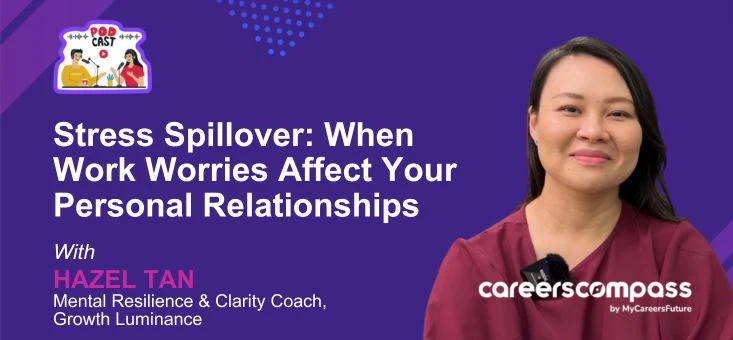
Hazel Tan, a Mental Resilience & Clarity Coach at Growth Luminance believes such habits are really about learning to self-regulate, and not seek validation, or be overly dependent on emotional support from partners, family and friends.
Drawing from her own experience, she shared how leaving a corporate job some years back and starting a French bakery with a friend was challenging to manage alongside family life—particularly in terms of how her decision would affect household finances and care for her daughter, who was in kindergarten at that time.
Key highlights to listen to
Hazel also shares about:
- (2:42) The relationship cost of making careers decisions without your partner
- (3:55) How to manage when work stress hits the fan, and stop stress spillover
- (6:05) Compassion fatigue: when you’re tired of playing therapist for close ones
Listen to the full podcast to learn how to protect both your career health and your relationships here!
Follow us on LinkedIn for more expert career guidance and industry insights: Workforce Singapore on LinkedIn
Stay updated with the latest trends, job market shifts and career health advice from WSG.