


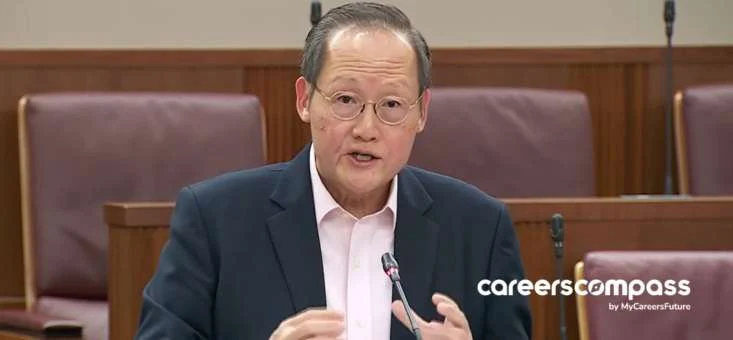
At the Committee of Supply 2026 (COS 2026), Minister for Manpower (MOM) Dr Tan See Leng reflected that while the nature of work is changing, Singapore workers remain in a “relatively good position”.
He shared that as of December 2025, the Singapore labour market has shown:
- 17 straight quarters of employment growth since we emerged from COVID in 2021
- More vacancies than jobseekers in 2025
- Real median income grew by 8.3% from 2020 to 2025 (1.6% p.a.)
- Lower-wage workers seeing real incomes grow by 15% from 2020 to 2025 (2.8% p.a.), faster than the median worker, bolstered by productivity improvements and targeted wage support
But there’s no way to ignore the reality that workers today have evolving expectations around work-life balance and changing priorities at different life stages. This shift has implications for everyone, according to Senior Minister of State for Manpower (SMS) Dr Koh Poh Koon.
“This means that careers are no longer about climbing a corporate ladder, but rather about navigating a dynamic, multi-stage journey – moving up, across domains or even intentionally downshifting to balance life’s priorities such as caregiving,” he said.
This also means taking greater ownership of their careers and skills and desiring more flexibility in work arrangements, SMS Koh added.
With these considerations in mind, Minister Tan announced MOM’s three priorities at COS 2026:
- To empower Singaporeans to build meaningful careers
- Enable businesses to transform and provide quality jobs
- Build more inclusive workplaces that leave no one behind
Here’s what Singapore workers can look forward to this year.
Increasing pay and progression for key sectors, and lower-wage workers
For key sectors
As mentioned by Prime Minister (PM) Lawrence Wong during Budget 2026, there are plans to increase pay and progression in education, healthcare, and social service.
Minister Tan shared MOM is also working with the labour movement and trade associations to make similar efforts for the skilled trades, or “hands-on” work, and will provide updates at a later stage.
For lower-wage workers
In addition, Minister of State for Manpower (MOS) Dinesh Vasu Dash added that as part of improvements to the Progressive Wage Model (PWM), the government will also raise the Local Qualifying Salary (LQS) that firms may pay local workers if they hire foreign workers.
The LQS threshold will be raised from $1,600 to $1,800 for full-time local employees from 1 July 2026.
“Raising the LQS to keep pace with wage growth ensures that locals are employed meaningfully, rather than token jobs just so that firms can access foreign workers”, MOS Dash said.
The Progressive Wage Credit Scheme (PWCS) will be extended to 2027.

Since the scheme was introduced in 2022, PWCS has supported wage improvement for lower-wage workers, even as firms undertake the longer journey of transformation.
These wage increases have been meaningful – the median monthly increase supported by PWCS was about $250, across more than 710,000 workers.
As such, the government will co-fund up to 30% of wage increases given to eligible lower-wage workers in 2026 – this is actually higher than the 20% which was originally announced. Co-funding support provided in 2027 and 2028 will be at 30% and 20% respectively.
MOS Dash announced that the extended PWCS support in 2027 and 2028 will also have a higher minimum qualifying threshold for wage increases of $200, from $100.
“This better encourages and rewards businesses that invest in transformation and workforce development, in line with PWCS’s objectives”, he said.
More long-form courses now available for Workfare Skills Support (WSS) Level-Up Scheme; higher allowances for shorter training
The WSS (Level-Up) scheme supports lower-wage workers in pursuing more substantive forms of upskilling and reskilling, without needing to worry about making ends meet.
Currently, trainees undertaking long-form courses will be supported with a Training Allowance significantly higher than existing WSS support for short-form courses.
These long-form courses include Nitec or Higher Nitec qualifications, Diplomas, Post-Diplomas or undergraduate degrees.
MOS Dash announced that the list of courses supported by WSS (Level-Up) will be broadened, to include long-form Workforce Skills Qualification (WSQ) full qualifications.
These courses will be similarly eligible for the Training Allowance under the SkillsFuture Level-Up Programme. The changes will take effect from fourth quarter of this year.
At the same time, the WSS (Basic) scheme will be enhanced to support workers undertaking shorter training.
This will better help workers meet their PWM training requirements or take up Workforce Skills Qualifications courses.
The Training Allowance for self-sponsored trainees from $6/hr to $10.50/hr, effective 1 July 2026, allows workers to actively consider training without having a significant reduction in pay.
The WSS (Basic) scheme will also be streamlined to reduce complexity: only trainees who attain full qualifications will receive the Training Commitment Award of $800 per year.
Full qualifications are sets of related courses that result in a formal qualification, such as WSQ Qualifications or Academic Continuing Education and Training Qualifications.
Updates to the Graduate Traineeships (GRIT) scheme
In 2025, the GRaduate Industry Traineeships (GRIT) scheme was introduced, alongside GRIT@Gov for the public sector.
Minister Tan shared that over 400 graduates in the 2025 cohort have already embarked on traineeships in various industries, and MOM will extend applications to the 2026 cohort, as well as speed up applicant onboarding.

If market conditions call for it, MOM will also expand capacity for the scheme, he added.
There have also been initiatives to enhance work-based learning and on-the-job training through schemes like the AI Apprenticeship Programme and the SkillsFuture Work-Study Programme (WSP).
The Work-Study Diploma was introduced in 2018 and has become an important upgrading pathway for ITE Nitec and Higher Nitec graduates.
Senior Minister of State for Education Janil Puthucheary announced that Ministry of Education (MOE) and SkillsFuture Singapore (SSG) will enhance the employer incentives for the ITE Work-Study Diploma for new cohorts from April 2026 by:
- Increasing the quantum of the incentive provided to Work-Study Diploma employer partners from $15,000 to $20,000, for each trainee that employers hire and train
- Simplifying the process for disbursing these incentives
The new $20,000 incentive will be fully disbursed at several milestones throughout the course duration. This means an employer who sponsors an eligible trainee through the full Work-Study programme will receive the full amount.
This will make it easier for employers to claim these incentives by reducing the administrative processes required to access the funding.
Up to 70% of traineeship costs are also subsidised through GRIT, Minister Tan added.
Giving Singapore’s talented workers a boost
Since launching in 2024, WSG’s Overseas Market Immersion Programme (OMIP) has already supported more than 120 local professionals to gain overseas experience.
According to Minister Tan, over 430 local workers have benefitted from the programme as of 2025, and it will be expanded in 2026 to support young professionals gaining overseas exposure even earlier in their careers, with details to be shared in due course.
MOM has also expanded the capacity and uptake of professional development programmes, for local workers who aspire to leadership positions to develop the skills to do so.
With support from the Economic Development Board (EDB), the Singapore Leaders Network run by the Human Capital Leadership Institute has grown to over 4,000 members, with new and expanded offerings. This includes the Overseas Transition Support programme, which has supported about 120 professionals.
Helping local workers build AI literacy

As announced at Budget 2026, those who take up selected SkillsFuture AI courses will receive free subscriptions to premium versions of best-in-class AI tools for six months.
This initiative will be open to all Singaporeans aged 25 and above.
Minister Tan announced that MOM has been engaging providers such as Google, Manus, Microsoft, and OpenAI, and will announce details in due course, including the tools and platforms that qualify.
Formation of Workforce and Skills Singapore (WSSG)
SkillsFuture Singapore (SSG) and Workforce Singapore (WSG) will merge into Workforce and Skills Singapore (WSSG), a new statutory board under MOM and jointly overseen with MOE.
It will be established in the third quarter of 2026, helmed by Dilys Boey, who is the current Chief Executive of WSG.
Its mission will be to:
- Empower Singaporeans to develop future-ready skills and access good job opportunities
- Enable businesses to create good jobs for Singaporeans and develop their workforce
- Promote a culture of lifelong learning and career health
Minister Tan said that this merger will help bring both agencies’ skills and employment facilitation capabilities under one roof, which will be a “single, powerful engine for human capital development”.
WSSG will collaborate with other agencies and stakeholders to benefit both Singapore workers and employers. Workers can look forward to:
- A single portal to access training, career guidance, and job opportunities, without having to navigate multiple agencies
- A combination of career and skills data, for a clearer picture of where opportunities are, enabling better-informed career and training decisions
For employers, they will benefit by having:
- More timely and comprehensive labour market and skills insights: WSSG can help to reduce skills mismatches and time-to-hire
- A single point of contact, which will also simplify support for local businesses to address hiring, training, and workforce transformation needs
WSSG will also strengthen its ecosystem of career and employment service providers to serve different workforce segments more effectively, delivered effectively through private service providers specialising in certain industries and sectors or workforce segments.
In a workgroup in partnership with the Alliance for Action on Advancing Career and Employment Services (AfA-ACES), nine pilots will be launched in 2026 with private sector partners to test new services, covering a range of individual and employer segments. For example:
- For fresh graduates: services combining career guidance and industry exposure to support your school-to-work transition will be tested
- For mid-level professionals: personalised career agents to help you move into better roles will be piloted
- For caregivers, seniors, and those facing greater hardship: new ways to support more flexible work options, or better still, a return to work, will be explored
- For SMEs: new ways to support internal mobility and suggestions of new work models will be tested
The workgroup will release its recommendations in the second half of this year, Minister Tan said.
Helping Singapore workers unlock career longevity
As previously announced, the retirement and re-employment ages will be raised to 64 and 69 respectively on 1 July 2026. There are further plans to raise them to 65 and 70 by 2030.

The Tripartite Workgroup on Senior Employment (TWG-SE) is developing a more integrated approach to support career longevity. This includes enabling individuals to plan earlier for later-stage career transitions, and equipping employers to design age-friendly jobs and workplaces.
In the interim, the Senior Employment Credit will be extended until December 2027 to continue supporting employers hiring senior workers.
In addition, retirement adequacy policies will be strengthened to give our seniors greater assurance.
According to SMS Koh, the Part-Time Re-employment Grant will also be extended to December 2027, to support employers in offering suitable part-time and flexible work options that attract and retain senior workers.
As such, CPF contribution rates will be increased in 2027 for senior workers:
- 5% more for workers aged above 55 to 60
- 1% more for workers aged above 60 to 65
This will better support retirement adequacy for seniors who wish and want to take the option to continue working.
Minister Tan also announced an extension of the CPF Transition Offset for another year to help cushion half of the increase in employer CPF contributions.
Supercharge your career growth with tailored jobs and to your profile. Try it now!
He also shared that new retirement sums for cohorts beyond 2027 will be announced, enabling members to better reflect the savings needed to meet basic retirement needs in the future.
There will also be a CPF Top-Up of up to $1,500 for eligible Singaporeans aged 50 and above for those with CPF balances below the prevailing Basic Retirement Sum. The top-up will be automatically credited in 2026.
Expansion of the Career Health movement
In 2025, Career Health SG was launched with the key message of staying proactive and pre-emptive about our careers.
The Careers & Skills Passport (CSP) lets you take stock of your skills, and CareersFinder helps you discover job options you may not have considered.

There was also an expansion of access to career planning programmes, with almost 9 in 10 respondents reporting having clearer direction and greater confidence after attending them.
These tools have delivered positive outcomes. Following the integration of CSP with job portals JobStreet and FastJobs, job applications with verified credentials are 1.5 times more likely to be shortlisted by employers, Minister Tan shared.
MOM will be expanding the CSP partnerships to five more job portals:
- MyCareersFuture
- Careers@Gov
- EASE
- FindSGJobs
- eFinancialCareers
In addition, CSP has also been integrated with HR tech firm JobTech’s platform, enabling employers to search for candidates based on verified skills data.
Searching for the right course, made easier
SMS Janil announced that SSG will revamp the MySkillsFuture portal to make it easier for individuals to find relevant training.
The upgraded portal will introduce:
- Curated course recommendations in in-demand skill areas such as artificial intelligence
- Occupation-based course exploration, allowing users to search courses aligned with their career pathways
- An AI-powered chatbot that provides personalised guidance on training options
SSG will also streamline the course enrolment process. Starting with selected training providers, individuals will be able to enrol directly on the MySkillsFuture portal using their pre-filled Singpass information, instead of submitting a separate application on the provider’s website.
These enhancements aim to make it easier for individuals to identify suitable courses and enrol in training aligned with their career goals.
More options to reskill and upskill with the SFLP

The SkillsFuture Level-Up Programme (SFLP) was introduced in 2024 to support mid-career Singaporeans aged 40 and above to meaningfully upgrade their skills.
It includes a SkillsFuture Credit (Mid-Career) top-up of $4,000, usable for about 7,500 courses, and the SkillsFuture Mid-Career Training Allowance that provides up to $3,000 per month for those pursuing full-time training.
SMS Janil also announced at the COS that the SFLP will see an expansion in course category to include Workforce Skills Qualification (WSQ) full qualification courses.
Stay informed and secure. Navigate your job search confidently with MyCareersFuture.
As part of a national skills credentialling system, such WSQ-accredited courses impart skills needed to perform various work tasks in line with industry manpower needs.
The inclusion of these courses ensures that SFLP learners can choose from a wider range of industry-relevant courses.
Around 200 WSQ courses are expected to qualify for the SFLP from Q4 2026, across a wide range of sectors such as Healthcare, Information and Communication, Engineering, Media and Early Childhood.
Accessibility for PwDs in reskilling and upskilling
SMS Janil said SSG and SG Enable will continue to work with community partners to raise training providers’ capabilities to deliver inclusive training, including in areas like AI.
Currently, they conduct regular workshops on inclusive training methodologies and accommodations. They also work with the Institute for Adult Learning (IAL) to develop courses for adult educators to better design and deliver inclusive training.
SG Enable also provides a capability development grant to help training providers who customise courses to meet the needs of persons with different disabilities. They are also working with SSG to explore ways to scale up the delivery of inclusive training by leveraging technology.
In terms of financial support, as of January 2026, the Matched Retirement Savings Scheme (MRSS) was expanded to include eligible Singaporeans with disabilities of all ages.
With this expansion, around 24,000 Singaporeans with disabilities below the age of 55 can benefit from the scheme this year, according to Senior Parliamentary Secretary for Manpower (SPS) Shawn Hwang.
He added that MOM will work closely with the Ministry of Social and Family Development (MSF) to examine how to better support persons with disabilities in our changing job market, through:
- Upskilling
- Reskilling
- Expanding opportunities
- Strengthening employer support
- Building career resilience
MOM will also continue working with partners to scale employment and strengthen post-employment support for persons with disabilities.
(Main Image: MDDI YouTube)
Follow us on LinkedIn for more expert career guidance and industry insights: Workforce Singapore on LinkedIn