

The transition from being a student into a full-time employee is a significant milestone and can be an overwhelming process — there’s no structured syllabus to follow and it’s up to you to figure out how to navigate the working world.
While a lack of full-time roles doesn’t mean you have less potential, writing a CV can still be challenging, especially when you don’t have much formal work experience to offer.
From internships and part-time jobs to school projects and volunteer work, there are many ways to demonstrate your skills, work ethic, and readiness for the workplace. Here’s how to structure your CV, highlight relevant experiences, and avoid common mistakes so you can present yourself clearly and confidently to potential employers.
Entry-level experience: Make use of skills from internships or part-time jobs
If you have completed internships, industrial attachments, or part-time roles, include them prominently in your CV — even if they were short-term. These experiences show that you have been exposed to real workplace settings and expectations.
When crafting your CV, tailor it to the jobs that you are applying for by highlighting the skills that you’ve picked up through these roles. If your internship or industrial attachment is relevant to the position you’re applying for, make it a point to list out examples of projects you’ve worked on and how you’ve contributed to them.
If your past part-time roles aren’t relevant to the position that you’re applying for, highlight transferable soft skills instead, which are versatile and can be adapted across different industries.

For example, if you often worked the peak shifts at a coffee shop, you could put down examples of time management, communication, and adaptability as skills you honed along the way.
In this way, your potential employers will have a clearer picture of your capabilities and how you would meaningfully contribute to the team. Below is an example of how you can phrase your internship or part-time work experience:
Marketing Intern I XYZ Pte. Ltd
- Collaborated with a team of marketing professionals to execute various projects, including social media campaigns, market research, and content development.
- Assisted in creating and scheduling social media content, resulting in a 25% increase in engagement rates within the first month of my internship.
- Conducted market research and analysed customer feedback to inform marketing strategies and enhance customer experience.
- Co-produced eight social media videos over a three-month period to boost online engagement, contributing to a 10% increase in website traffic.
Barista | ABC House
- Strengthened team communication by enforcing kitchen call-and-response, leading to 85% decrease in missed orders.
- Improved time management by firing multiple orders for drinks at one time, shortening order-to-pick-up time from an average of 3 minutes to 1 minute and 45 seconds.
- Applied data analytics to determine the most-ordered items and prepare inventory ahead of time, which contributed to 20% increase in customer satisfaction.
Highlight transferable soft skills derived from non-work experience
If you have not had any short-term work experience at all, there are other ways to strengthen your CV when applying for jobs. Notably, experience in school activities can still provide plenty of information about your character and soft skills.
You can list down leadership positions you’ve held in school projects and your co-curricular activities where you’ve made meaningful contributions. For instance, being a peer counsellor shows compassion and reliability. And if you were on the executive committee of a sport, that can show leadership and organisational qualities.
Extra hustles outside of school, such as volunteer work at an animal shelter or tutoring children, can be included too. These activities show that you’ve developed transferable skills such as leadership, teamwork, and interpersonal skills, which are sought after in a professional working environment.
You can even include examples to show how you’ve managed to hone these skills. For instance, knowing how to resolve conflicts among team members or leading a team through a tight deadline show potential employers how you might handle similar situations at the workplace.
Here’s an example of how you can apply your co-curricular experiences to your CV:
Co-curricular Activities:
- Peer counsellor: Pioneered exam welfare programmes providing snacks and letters of encouragement to students.
- Captain, Football Club: Collaborated with club leaders to plan training programmes to improve team’s skills. Planned socialising events to help team bond together and improved communication among team members.
- Volunteer, SPCA: Participated in weekly shelter operations, such as enrichment with the animals and cleaning enclosures, as well as organising fundraiser events.
Check the format first before you start writing
Now that you know what information to include in your CV, the next step is ensuring that you use a clear and professional format to frame your CV.
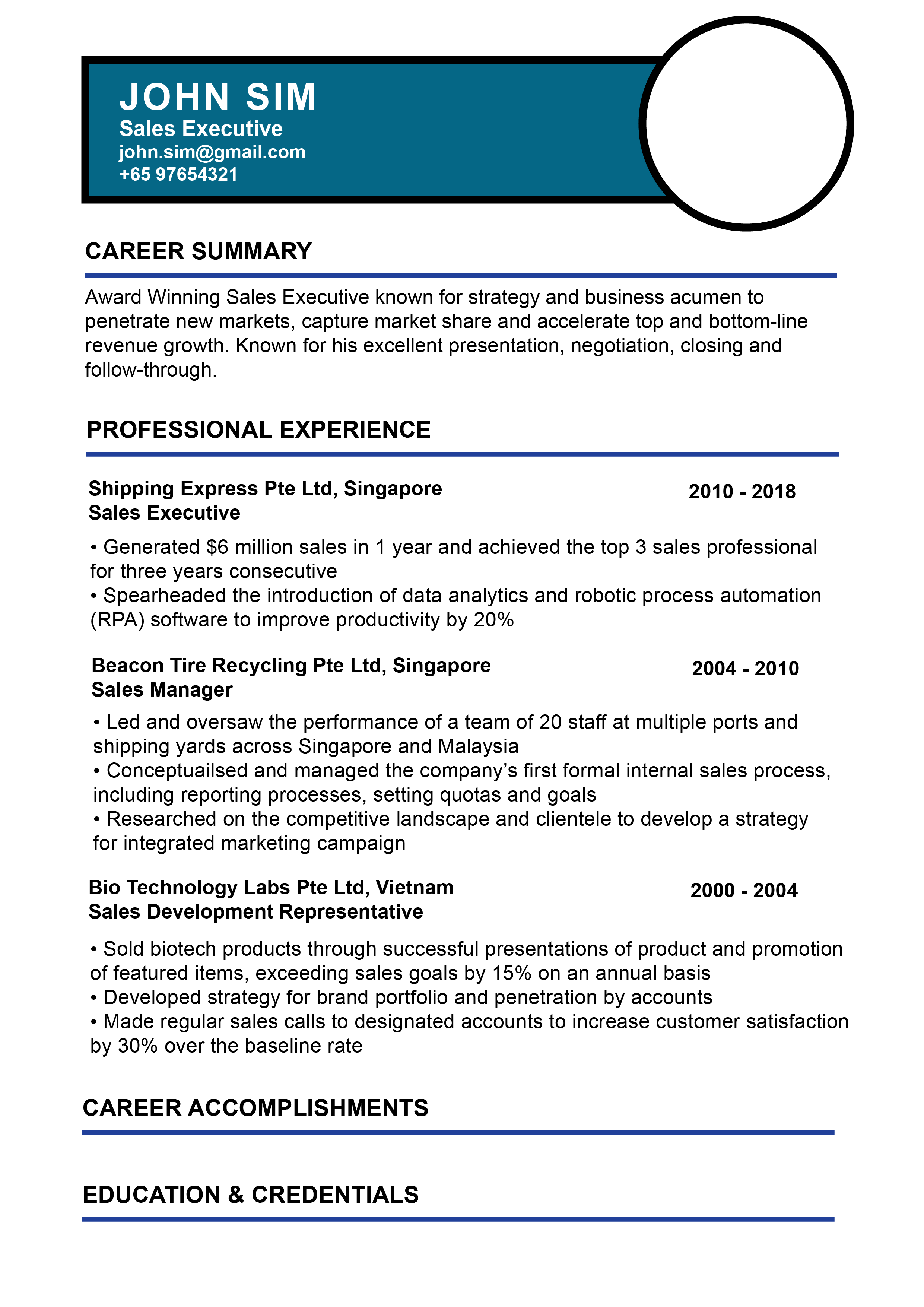 Start with a simple layout and clear headings to make it easier for hiring managers to spot information quickly. For fresh graduates, one page is often sufficient to fill in all relevant information.
Essential details required in your CV:
- Full name
- Contact Number
- Email address
- Short summary of yourself relevant to the position
- Current education level and relevant coursework
- Part-time work experience
- Technical and soft skills acquired
Recruiters typically spend only a few minutes reviewing each CV out of hundreds of applications. So, it’s important to ensure your CV is written in an easy-to-read format for employers to notice your qualities instead of the distractions from unnecessary details.
Personal information like your NRIC, home address, and marital status are not required, while photos should only be sent in when requested by the employer.
We’ve included a sample CV on how to structure your particulars and experiences at the end of the article that you can use as a reference.
Common CV mistakes that you must avoid
Your CV is the first thing that your employer would be looking at before determining your suitability for interviews. As such, you should review your CV and ensure it’s been edited and cleaned before submission.
A few common mistakes that job applicants tend to make are:
- Using vague descriptions to describe their work or schooling experience.
- Poor formatting, such as using multiple fonts, having huge chunks of text, and unclear sections.
Instead, you should:
- Be detailed about your experience. State two or three projects you’ve worked on and how you meaningfully contributed to them.
- Quantify your experiences. For example, “co-produced eight social media videos in three months” clearly demonstrates your track record.
- Check and amend any spelling and grammar mistakes.
These details may seem small, but they create a lasting impression that can affect whether you get shortlisted for a job.
Putting your experience to good use
Crafting your CV is often the first step in your job search journey. By understanding job requirements and showcasing your strengths, you can approach the job application process with confidence and raise your chances of getting employed.
Join us at Careers Connect On-The-Go for free career advisory, networking and on-site interviews!
By highlighting strengths and relevant skills picked up in part-time work and school projects, your CV can still leave a strong impression on potential employers and help you take confident steps towards building your future career.
For additional support and resources regarding career guidance, CV writing, and interview preparation, explore the career guidance tools and resources available on CareersCompass by MyCareersFuture, including CV writing tips and interview preparation guides.
Here are some preparation guides that you can explore:
- Resume for Students (Writing Tips, Samples and Skills)
- 6 Most Common Interview Questions & How to Answer Them
- Fresh Grads: SPARK Off Your Career With the Career Starter Pack
- 7 Things No One Tells Fresh Grads About Job Hunting
Sample CV for reference
The sample below serves as an illustrative guide for your CV. Please adapt it to reflect your own accomplishments, but don’t feel obligated to include every section shown.
John Lin
8123 4567 | john.lin@email.com
Education:
Bachelor of Science in Business Administration – National University of Singapore
Relevant Coursework:
- Marketing Management: An in-depth study of marketing strategy, consumer behaviour, advertising, and promotion. Developed skills in market research, branding, and digital marketing.
- Managerial Accounting: Focus on financial and managerial accounting concepts, costing systems, budget planning, and decision analysis. Developed skills in financial statement analysis, cost behaviour, and variance analysis.
- Business Ethics and Social Responsibility: An examination of the legal and ethical responsibilities of businesses, sustainability, corporate governance, and social impact. Developed skills in developing and evaluating business strategies relating to key ethical issues.
Work Experience (if any):
Marketing Intern I XYZ Pte. Ltd August 2019 – December 2019
- Collaborated with a team of marketing professionals to execute various projects, including social media campaigns, market research, and content development.
- Assisted in creating and scheduling social media content, resulting in a 25% increase in engagement rates within the first month of my internship.
- Conducted market research and analysed customer feedback to inform marketing strategies and enhance customer experience.
- Co-produced eight social media videos over a three-month period to boost online engagement, contributing to a 10% increase in website traffic.
Relevant Coursework or Projects:
- Market Research Project: Conducted a market research project on the perfume industry, including a questionnaire survey of 500 respondents. Analysed data using SPSS and created a report of findings and recommendations.
- Digital Marketing Project: Developed a digital marketing plan for a new startup company. Conducted a SWOT analysis, identified target audience segments, created social media content, and developed a budget plan.
Barista | ABC House July 2018 – September 2018
- Strengthened team communication by enforcing kitchen call-and-response, leading to 85% decrease in missed orders.
- Improved time management by firing multiple orders for drinks at one time, shortening order-to-pick-up time from an average of 3 minutes to 1 minute and 45 seconds,
- Applied data analytics to determine most-ordered items and prepare inventory ahead of time, which contributed to 20% increase in customer satisfaction.
Skills
Technical Skills:
- Microsoft Office Suite (Word, Excel, PowerPoint)
- Adobe Creative Suite (Photoshop, Illustrator)
- Social Media Management (Hootsuite, Buffer)
- Data Analysis with SPSS, Excel
Soft Skills:
- Strong Communication (verbal and written)
- Team Collaboration (cross-functional teams, diverse workgroups)
- Problem Solving (analytical and strategic thinking)
- Time Management (multitasking, prioritising, meeting deadlines)
Co-curricular Activities:
- Peer counsellor: Pioneered exam welfare programmes providing snacks and letters of encouragement to students.
- Captain, Football Club: Collaborated with club leaders to plan training programmes to improve team’s skills. Planned socialising events to help team bond together and improve communication amongst one another.
- Volunteer, SPCA: Participated in weekly shelter operations, such as enrichment with the animals and cleaning enclosures, as well as fundraiser events.
Awards and Honors:
NUS Achievement Scholarship, National University of Singapore, May 2020: Awarded to students with an exceptional academic record and demonstrated financial need.
References:
References are available upon request.
Follow us on LinkedIn for more expert career guidance and industry insights: Workforce Singapore on LinkedIn
Stay updated with the latest trends, job market shifts and career health advice from WSG.