


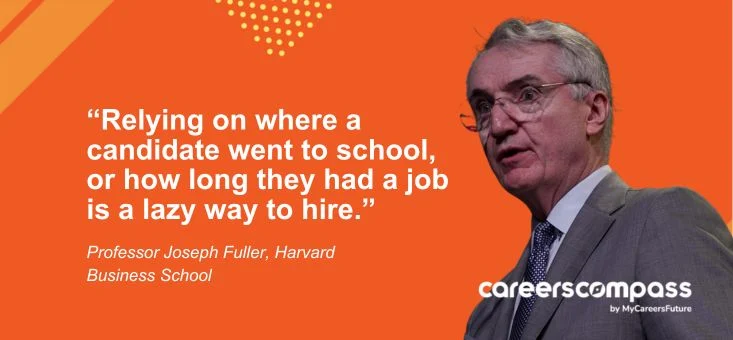
Watch to learn how ignoring skills-first practices can hurt Singapore employers!
At Workforce Singapore’s recent Career Health Summit, keynote speaker Professor Joseph Fuller from Harvard Business School shared how talent is becoming more important than ever, and how the future needs a skill-first management mindset.
Examples of skills-first practices
Skills-first practices are specific strategies and approaches that organisations implement to prioritise and leverage employee capabilities over traditional job structures. Some key practices include:
- Skills-based hiring and recruitment
- Skills mapping and inventory
- Internal mobility based on skills
- Project-based team formation
- Skills-based performance management
- Targeted skills development programmes
- Skills-based succession planning
These practices help organisations become more agile, make better use of their talent, and respond more effectively to changing business needs.
Yet, as Professor Fuller shares, our Asian culture leads us to have “a great respect for distinguished institutions”, and about “stature and face”.
This can be a big hindrance to skills-first management and hiring, simply because the process needs leaders to start leaving out traits and credentials that aren’t relevant to jobs and the positions they are hiring for!
Nilay Khandelwal, Senior Managing Director, Michael Page Singapore and India, recently shared that “new collar jobs” have emerged in response to rapid technological advancements, automation, and industry shifts.
Sharpen your hiring strategy. Get top candidates on MyCareersFuture.
“Employers are realising that formal education is not always the best indicator of capability—what truly matters is whether a candidate has the right skills and mindset to perform in a fast-evolving workplace.”
“Industries like tech, fintech, and advanced manufacturing are leading the shift.”
“Healthcare, particularly in areas like medical technology and telehealth, is increasingly hiring based on skills rather than degrees,” he added.
How employees benefit from skills-first practices
Skills-first practices enable enhanced career mobility, allowing employees to transition between roles and industries by leveraging transferable skills rather than being confined by job titles or educational backgrounds. This approach also accelerates professional development through targeted training that directly enhances skill sets and market value.
These benefits ultimately future-proof careers by helping employees develop diverse skill portfolios that remain relevant across changing job markets, providing greater job security, job satisfaction, and advancement opportunities based on actual contributions rather than tenure alone.
Ultimately, change needs to be led from the top, and if leaders don’t change themselves, employees and workers may not believe they have opportunities themselves for professional development and growth.
In fact, this very aspect is the single top factor for Asian employee satisfaction and belonging, according to research.
This can hurt employers’ bottom lines, according to a Gallup finding, where disengagement in employees can cost up the 34% of their annual salary.
Watch this video to learn how to lead from the front when it comes to skills-first management!
As a business leader, you play a key role in shaping the future workforce. Follow us on LinkedIn for insights into building a resilient workforce, internal mobility, and the latest workforce trends.
Follow Workforce Singapore on LinkedIn
Stay ahead of the curve with expert advice on hiring, retention, and workforce development.