

Your questions about career conversions answered
-
What challenges do Singapore businesses face with career conversations?
-
How can managers conduct effective career conversations?
-
What value do WSG’s Career Conversations Guidebooks provide?
It’s a new employment market trend: Managers are starting to oversee more staff. This comes as companies — both MNCs and SMEs — have started moving away from excess levels of middle-management, and building nimbler yet larger buildings.
Data from research and advisory firm Gartner shows that middle managers now manage three times the staff numbers compared to almost a decade ago.
At the same time, staff members are also crying out for more regular career conversations. This is especially so with employees’ career health becoming a greater concern brought upon by the rising need for reskilling and upskilling, and the unsettled economic sentiment.
Need talent? Post jobs to 500,000+ locals now. Find your next hire on MyCareersFuture today.
In fact, according to a Right Management survey, 82% of employees would be more engaged if their managers held regular career conversations.
But here’s the bigger question: How can they be done — and done right — so that both organisational and worker objectives and concerns are met?
Meet Workforce Singapore’s (WSG) Career Conversations Guidebooks (CCG).
Easy framework for employers, managers and employees to use
The CCG is useful to unlocking mutually beneficial career conversations, exploring new opportunities and driving both personal and company-wide success.
Designed to be user-friendly, this structured and comprehensive guidebook helps fosters meaningful dialogues about professional growth to align employee aspirations with organisational goals.
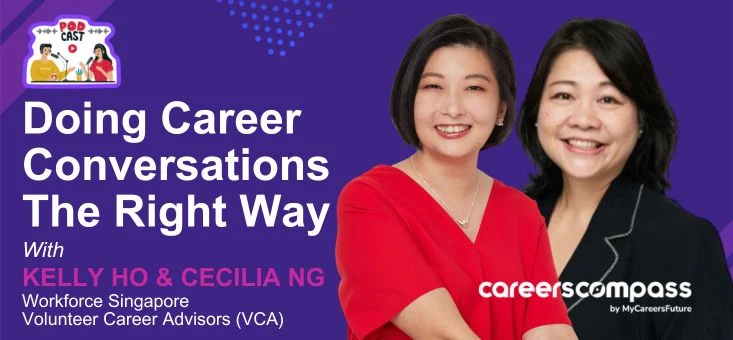
We speak to Cecilia Ng, the Regional People Partner Lead at Zebra Technologies Asia Pacific, and Kelly Ho, Group Director of Human Resources at The Fullerton Hotels & Resorts, who share more on:
- Why career conversations matter
- Why some Singaporean employers and managers have issues doing them well
- How to go about having them
- Why WSG’s CCG can help
Both Cecilia and Kelly are WSG Volunteer Career Advisors. In their role, they’ve mentored peers, shared their professional experience and knowledge, and provided the last-mile connection to relevant government services for interested Singapore workers to upskill/reskill, or make smoother career transitions.
Hire smarter, faster! Use MyCareersFuture’s innovative tools to find the right fit in record time.
The Volunteer Career Advisors (VCA) initiative is a community-driven effort designed to support individuals in navigating their career journeys with confidence.
Launched with the aim of fostering career resilience and growth, the initiative connects individuals with industry experts from diverse industries who volunteer their time and expertise.
In your experience as a HR practitioner and leader, as well as an employee yourself, do you think Singaporean workers want more career conversations?
Kelly: I believe the impact of career conversations depends more on quality than frequency. In my experience, meaningful, personalised discussions do enhance engagement, but only when they are sincere and tied to real development opportunities.
Cecilia: Yes, I agree with the Right Management survey results, and am happy to see a high percentage of agreement that career conversations matter. We should work on the 82% and convert the remaining 18% as well!
How important do you think career conversations are in keeping staff and employees abreast of their own career health, and how does this benefit employers?
Kelly: They are crucial for both sides, helping employees reflect on their goals, spot development gaps, and stay motivated. For employers, it results in better retention, a stronger talent pipeline, and a more engaged team that is aligned with business needs.
Cecilia: Beside work performance and responsibilities, initiating such dialogues reflect the organisation’s commitment to engage, listen, coach and develop employees’ strengths and areas for improvement, consistently take interest in the employee’s future.
This drives employees’ motivation and engagement that the employer cares for their career health, which in turn improves work performance, skillsets, and productivity.
When employees feel supported, they are more likely to stay with the organisation. This reduces turnover rates, and thus retains knowledge and skills within the organisation.
What do you think are some of the challenges Singapore businesses and employers have in inculcating regular career conversations as part of the manager-worker and employer-employee dynamic, operationally and culturally?
Kelly: One of the key challenges Singapore businesses face in embedding regular career conversations lies in shifting mindsets, both operationally and culturally.
Operationally, many managers are stretched thin, and career conversations are often deprioritised in favour of immediate deliverables.
Culturally, some still see development as the employee’s responsibility. Plus, not all managers feel confident having open, future-focused chats.
Cecilia: In Singapore, there is a challenge of raising a culture of speaking up and engaging in open discussion.
In addition, we tend to be task and results-oriented, and managers don’t always know how to conduct meaningful conversations. In addition, a broader ability to link investment in human resources with corporate goals and productivity can be a challenge for some leadership.
What tips do you have when it comes to dealing with these challenges?
Kelly: Start with small steps — build career chats into regular check-ins. Provide managers with simple prompts to guide the conversation. Keep it informal, and most importantly, create a safe space where growth — even beyond the current role — is okay to talk about.
Cecilia: Provide a structured guide and tools to help the managers to conduct the development conversations with team members.
Cultivate an inclusive leadership culture to instil trust and openness, and recognising a diverse workforce we have, and build a “every manager is a coach” mentality!
What’s your own personal advice in running a career conversation, in general?
Kelly: Listen more than you speak. Approach the conversation with genuine curiosity — not to provide all the answers, but to help the person reflect, explore possibilities, and identify their next small step forward.
Cecilia: Beside understanding the stage of the employee’s lifecycle, it is critical to align the objectives and possible outcome with the individual. Focus on their career aspirations and help facilitate options and linking action to development needs, while also compartmentalising the short- and long-term goals. I do apply the Maslow’s Hierarchy of Needs model as it drives individuals’ motivation differently, to better craft their development needs.
Having checked out WSG’s Career Conversations Guidebooks, what do you think about the guidebooks, in terms of relevance and value for employers, managers and employees alike?
Kelly: The CCG is practical and timely for a start. The guidebooks break things down clearly and give managers the structure and confidence to start meaningful conversations.
It’s especially helpful for those who may not have had much experience doing this.
What stood out to me were the conversation starters and examples tailored to different career stages.
I also appreciated the emphasis on listening and co-owning the conversation by using some of these tools to support our managers better.
Cecilia: The CCG provide a structured and holistic approach to conducting career conversations, offering practical tools and strategies for managers. They are a valuable resource for employers and managers seeking to drive employee engagement, productivity and growth.
The objectives are clearly defined, and the employee needs are identified to prepare for discussions creating a more supportive environment and culture.
I like the VIPS framework in the development plan, which is personalised and well-defined. It recognises one’s Work Values, Personal Interests, Personality Traits, and Skills (including motivated skills), and provides clarity, direction and motivation in the professional development. It also helps to align individual goals with the organisation, fostering better performance and engagement, leading to greater job satisfaction and fulfilment.
The Career Conversations Guidebooks can be downloaded for free here.
Follow us on LinkedIn for more expert career guidance and industry insights: Workforce Singapore on LinkedIn
Stay updated with the latest trends, job market shifts and career health advice from WSG.