


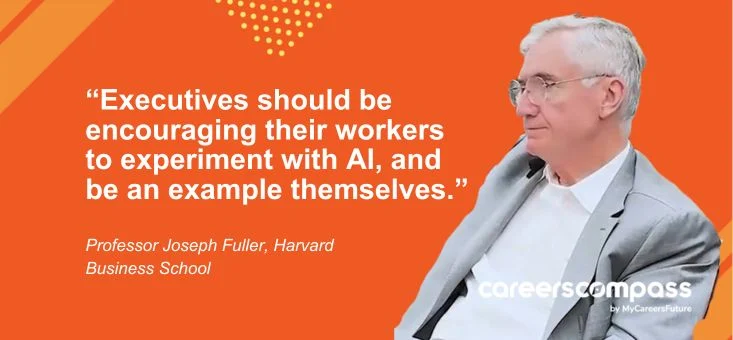
Watch this video to learn how to lead from the front when it comes to AI adoption at the workplace!
At Workforce Singapore’s recent Career Health Summit, keynote speaker Professor Joseph Fuller from Harvard Business School shared how AI is rapidly affecting workers from all walks of life, at all seniority levels… except leaders, it seems.
As it stands, it’s quite shocking that a recent McKinsey study found that 80% of companies using generative AI have seen “no significant bottom-line impact”, with 42% scrapping AI projects. Another study by MIT revealed that 95% of the AI pilot projects at the big companies they surveyed were deemed failures.
Employers should really be asking themselves:
- Do they invest in training for employees to help them understand AI?
- Are there AI policies that state clearly what these tools can and cannot be used for? And who can, or cannot, use them for work?
- Is there a designated staff member who handles and manages all approved AI-based tools? Has this person been trained or hired with the right technical skills?
Fundamentally, employers need to have a plan to use AI effectively, not just leave employees to work it out from the ground up “organically”.
Another staggering statistic: While many young workers are using AI tools at work, half of them are hesitant to admit how much of their work is created by them, according to a report by Cox Business.
The reason: They fear that AI could replace their jobs, or are unfamiliar with their company’s AI policy — or the lack of one altogether.
Furthermore, over 60% simply use personal apps or software at the workplace, rather than approved tools, which create security risks.
At the same time, 70% felt overwhelmed by the increasing number of tools provided by IT departments to “increase efficiency”, while only 16% felt they had any influence over the tools provided.
The current way many companies have approached AI simply doesn’t allow for the setting of clear performance indicators to measure the effectiveness of AI within the organisation. In the end, AI becomes a cautionary tale rather than a way to maximise productivity and profitability— and the buck stops with leaders, after all!
How bosses can measure the success of AI adoption in their company
When evaluating AI adoption success, focus on quantifiable productivity gains by establishing baseline measurements before deployment. Tracking metrics like task completion times, error rates, and output volumes, while monitoring post-implementation improvements can be useful.
Cost savings also provide concrete measures of AI success, though they often manifest beyond direct labour reductions. Track immediate savings from reduced manual work and error correction, but also monitor longer-term benefits like faster time-to-market, improved customer retention, and enhanced data-driven decision making.
The most effective approach combines hard metrics with qualitative assessments—employee satisfaction with AI tools and customer experience improvements provide crucial context for sustained transformation success. How Singapore bosses can leverage on artificial intelligence tools to help them in their work and improve efficiency
As a business leader, you play a key role in shaping the future workforce. Follow us on LinkedIn for insights into building a resilient workforce, internal mobility, and the latest workforce trends.
Follow Workforce Singapore on LinkedIn
Stay ahead of the curve with expert advice on hiring, retention, and workforce development.