


Change is inevitable, and it applies to your workforce too. SkillsFuture’s special edition publication Jobs-Skills Insights notes that all job roles are seeing varying degrees of shifts in skill requirements over the years, even if job titles remain unchanged.
The report shows 64% of Singapore’s resident workforce in PMET (Professionals, Managers, Executives, and Technicians) roles, up from 58% in 2019, which underscores a significant shift in the skills that are required by employers.
With technology, automation, digitalisation, and new business models reshaping what workers do every day, it’s no wonder job roles don’t stay the same for long. Even familiar roles are evolving in ways that employers may not fully see — until skill gaps start affecting productivity, efficiency, or individual and organisational growth.
But what if companies can identify the specific skills within each job that are shifting in importance? That’s exactly what the Job Requirements Skills Index (JRI) provides.
Make better hires, faster. Join thousands of employers on MyCareersFuture today!
Introducing the JRI, a simple way to identify skill change
Every job has a set of defining skills that differentiates one role from another. The JRI measures how much these defining skills have changed by assessing four different shifts in job skills and combining their impact into a single index, based on whether:
- Existing skills have become more important
- New skills have been added
- Existing skills have become less important
- Certain skills have faded entirely from the role
Let’s look at an example of how the JRI captures critical changes in an Engineering (operations and maintenance) role via four aspects of change in its defining skill clusters.
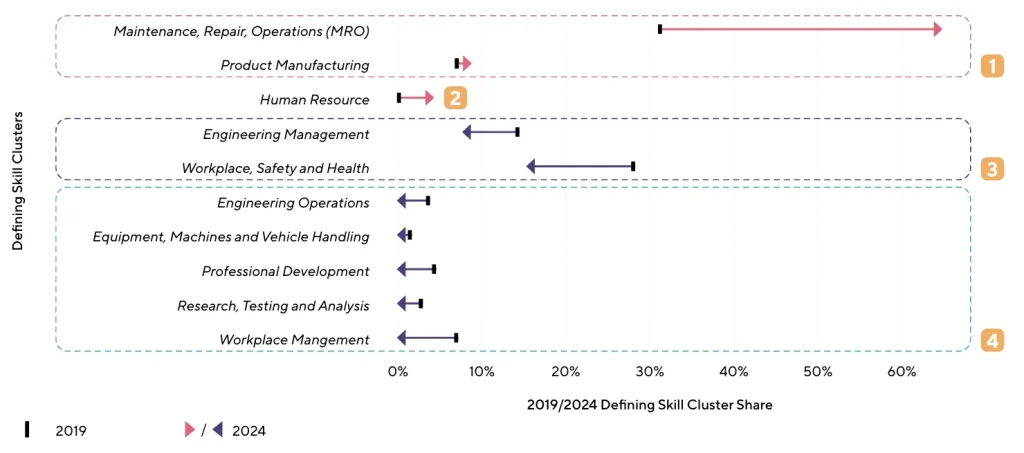
Here’s what it found for the above Engineering role:
- Increased emphasis on skill clusters (proportion of existing Maintenance, Repair, Operations (MRO) and Product Manufacturing defining skill clusters in the job requirements increased from 2019 to 2024)
- New defining skill clusters (Human Resource was a defining skill cluster in 2024 but not in 2019)
- Decreased emphasis on skill clusters (proportion of existing Engineering Management and Workplace, Safety and Health defining skill clusters in the job requirements decreased from 2019 to 2024)
- No longer defining skill clusters (five skill clusters are no longer defining skill clusters in 2024)
Higher JRI scores reflect greater change in defining skill clusters of a job, often due to the above four aspects of change. It helps us to understand where transformation is happening, which defining skill clusters are changing, and how to respond in a targeted and timely way.
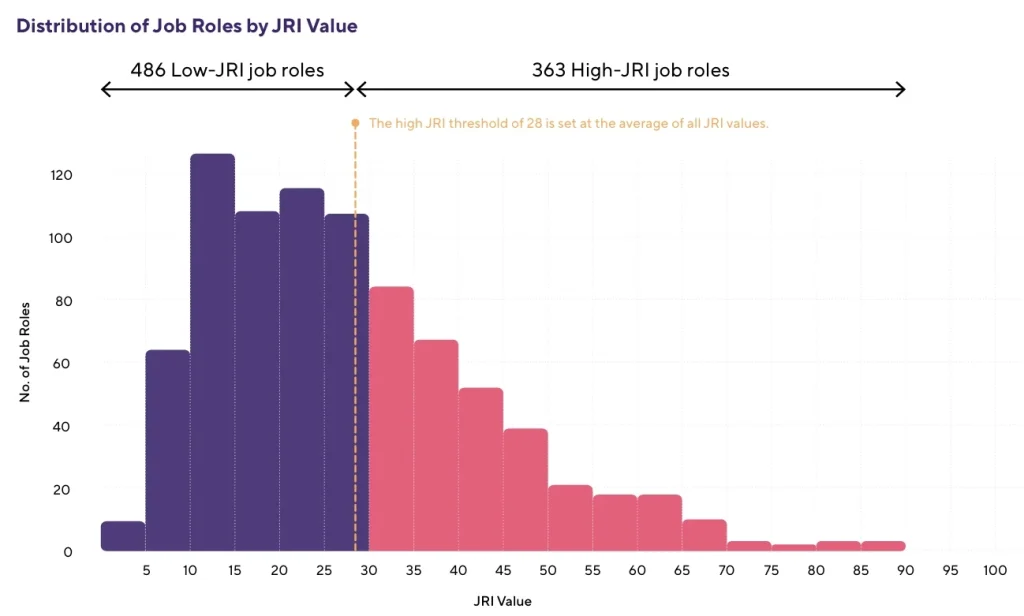
Using job posting data from 2019 and 2024, the JRI tool then analyses the magnitude and nature of change in each job. The result? JRI scores (on a scale of 0 to 100) for over 800 roles — with values ranging from as low as 2, to as high as 89, and a JRI threshold of 28 set at the average of all JRI values:
High vs low JRI scores — what do they mean?
So, do high JRI scores spell trouble for your business? And do low JRI scores imply role stability? We speak to Yeo Wee Siong, Group Director, Skills Development Group at SkillsFuture Singapore, for more insight on how companies can interpret the JRI.
High-JRI roles are fast-changing and high-risk
A higher JRI score simply means that the role has undergone more significant skill shifts. Wee Siong explains that these roles are often reshaped by new and evolving technologies, tools, and business demands, which means skills requirements shift faster, and employees in these positions may need frequent reskilling.
Examples of high-JRI roles and their JRI scores are as follows:
- Heads of technology, information and cybersecurity risk management (86)
- Assistant market development managers (64)
- Production engineers (48)
- Business intelligence managers (45)
- Food manufacturing nutritionists (36)
Low-JRI roles are stable for now, but not safe forever
A lower JRI score, therefore, means relatively lesser changes in skill shifts. However, Wee Siong cautions that it doesn’t make them safe or immune from future disruption. “Employers may still face sudden shifts in the future, especially when new technology, automation, or innovative processes are introduced.”
Post your job and reach thousands of active jobseekers in Singapore.
Examples of low-JRI roles and their JRI scores are as follows:
- Facilities engineers (25)
- Account operations managers (19)
- Data scientists (8)
- Workplace safety and health coordinators (5)
- Sales executives (3)
Turn your JRI insights into action
You’ve got the tool. You’ve got the data. Now what? Wee Siong advises companies to adopt a proactive and skills-first approach by using the JRI as a practical guide to redesign jobs and identify targeted upskilling and reskilling needs.
1) Redesign roles
For roles with high JRI scores, simply sending employees for training is not enough. That’s because as jobs change, so do their tasks, responsibilities, workflows, and tools. To reflect new realities, it is essential for firms to explore redesigning roles.
This is where Workforce Singapore’s Workforce Development & Job Redesign support becomes critical. As the Support for Job Redesign under the Productivity Solutions Grant (PSG-JR) concludes on 31 December 2025, it is replaced by the new and enhanced Enterprise Workforce Transformation Package (EWTP).
Rolled out progressively from 2026, the EWTP is designed to provide more holistic and integrated support for enterprises undergoing workforce transformation. Under the EWTP, eligible firms can:
- Access the SkillsFuture Workforce Development Grant (WDG), which offers enhanced support for job redesign as part of broader workforce transformation efforts
- Tap on the redesigned SkillsFuture Enterprise Credit (SFEC) to help defray out-of-pocket expenses for relevant workforce transformation programmes
2) Target reskilling where the change is fastest
Knowing what roles face the biggest shifts allows companies to effectively direct their training budgets. This ensures reskilling efforts are aligned with both immediate and long-term business goals.
3) Support internal mobility
Using JRI insights alongside career coaching or advisory services can also help employees pivot or progress as their roles evolve, which in turn improves internal mobility.
4) Strengthen talent retention
Firms that use JRI insights to reskill and redesign fast-changing roles tell workers one thing: their growth matters. When employees see their company actively investing in helping them stay relevant, loyalty naturally rises, and turnover reduces.
Futureproof your business today
It starts with having clearer visibility into how roles are changing, rather than assuming a one-size-fits-all view of job evolution. While the JRI is not meant to map every role in the economy, it’s been designed to serve as a practical reference point — helping employers like yourself better interpret shifts within their own workforce and industry.
Used in this way, the JRI goes beyond being a measurement tool. It can support firms in identifying which functions are changing most rapidly, anticipating emerging skill gaps early, understanding the defining skills that are growing in demand, and guiding efforts to build a workforce that is better prepared for future demands. Knowing your job requirements using our job requirement skill index tool is important!
As a business leader, you play a key role in shaping the future workforce. Follow us on LinkedIn for insights into building a resilient workforce, internal mobility, and the latest workforce trends.
Follow Workforce Singapore on LinkedIn
Stay ahead of the curve with expert advice on hiring, retention, and workforce development.