

Up to the point where Christina Kuek secured a job after taking a career break, this article would have been our stereotypical success story.
Her story still counts as a success in our book, but for different reasons. As she shared: “My sharing of my journey back into the workforce was meant to be my career break in 2024, where I spent 6-8 months care taking for my late father.
“For the rest of that year I had been actively seeking my next job, and eventually secured a role with a single-family office in January 2025.”
“However, after nine months, I decided to leave the position, and am currently in the process of exploring new opportunities. “
Read on to learn why.
Find your next job now on MyCareersFuture. 100,000+ jobs updated daily!
About Christina
Christina is a Certified Senior HR Professional (IHRP-SP) with over 16 years of expertise in HR operations, talent management, and employee engagement.
Over the years, she built up a strong record of building HR functions from the ground up, transforming workplace culture, and implementing data-driven solutions to enhance organisational performance.
Why she chose to take a career break
Over her long career, there were many variables that she had to consider, but perhaps what made it easier was that it wasn’t her first time taking a career break — in fact, it was her fourth!
Christina shared that her first career break was a two-year period after spending 12 years in a private bank in 2014. She subsequently took two career breaks over a one-year period in June 2018.
“The 2024 time off was the easiest decision to take as my father’s health and well-being took precedence. I weighed financial stability, career momentum, and family needs—and ultimately chose to be present for my father during a critical time.”
Planning her return to the workforce
“I began considering a return to work around the third quarter of 2024, once my caregiving responsibilities became more manageable”, she revealed.
It wasn’t a seamless transition — and Christina revealed there were moments of self-doubt. She had also encountered age-related bias over the course of her job search due to her age, but stayed focused on re-entering the workforce driven by “a clear sense of purpose and commitment”.
Of course, the HR industry also experienced changes during her absence, especially after the Covid-19 pandemic.
“There was a stronger focus on technology, employee well-being, and expectations around agility and data literacy,” she said: “During my third career break in 2021, I took the opportunity to stay relevant by enrolling in a six-month full-time mid-career pathway program with SkillsFuture Singapore and RISE by BCG.”
“That training equipped me with in-demand digital skills and helped me adapt to the rapidly changing digital landscape!”
How career coaching provided the missing piece
In addition, Christina was aided by Amanda Tan, a career coach from the Polaris by AKG programme, a career guidance initiative supported by Workforce Singapore (WSG) designed to empower Singaporeans to take charge of their career journey, whether they are currently employed or seeking re-entry into the workforce.
“I was seeking structured support and expert advice on my job search when I discovered Career GRIT, which has since been rebranded as CareersHorizon by MyCareersFuture, and enrolled in the Career Matching Programme with a Career Consultant from AKG”, she shared.
“The consultant (Amanda) was attentive and personalized her guidance, and the regular check-ins and encouragement provided valuable emotional support during a difficult transition.”
Within two months, Christina secured a job offer in December 2024 and started work in January 2025. At that time, she felt that accepting the job offer at a Single Family Office (SFO) was the right fit, and aligned with her HR expertise.
The hard realities of starting a job search… again
Nine months later, Christina felt that there was a cultural mismatch. For some, the fear of not being able to find another suitable job after successfully finding one might have kept them job hugging, but Christina felt it was the right choice.
“Leaving the role wasn’t something I took lightly especially after taking a year of career break, and I put in a lot of effort into restarting my journey”, she said.
“In the role, I built the HR and Admin functions literally from the ground up and contributed meaningfully to the company.”
“I tried to adapt and look at things from different angles, but it reached a point where I had to be honest with myself.”
So after a lot of reflection, she made the difficult call to leave.
For those who might be in similar situations of being in a job that turns out to be the wrong fit, Christina advises: “I think the first step is really listening to yourself.”
“When you’re constantly feeling drained, or when your role doesn’t align with your values or well-being anymore, those are signs to pause and take stock.”
But at the same time, we all know that leaving a job isn’t just an emotional decision — it’s also a practical one. The job market has its cycles, and sometimes hiring slows down for months, she added.
She tells those in the same boat: look at your financial runway, think about your family responsibilities, and plan ahead.
“For me, the right time to leave is when you’ve tried your best to improve the situation, but your mental health, your growth, or your sense of self keeps taking a hit.”
“When those things are at stake, and you’ve prepared for the transition, choosing to walk away can be the healthier, wiser choice.”
Reset, recharge, to get ready to go again!
Christina shared after she had left her last job, she gave herself permission to take a breather.
“I travelled a little, recharged, and just allowed myself to reset — something I didn’t realise I needed until I slowed down.”
At the same time, she stayed connected to the HR world, attending networking events, webinars, and workshops, partly to keep herself updated, and partly to maintain her HR Continuing Professional Development (CPD) hours.
Those interactions with other HR professionals were really uplifting and reminded her why she was in love with the HR industry!
She concluded: “I’ve also been reflecting on the kind of environment I want to grow in next – one that values respect, clarity, and healthy collaboration.”
“I’ve been exploring roles where I can bring that mix of operations, HR foundation-building, and people-centred thinking.”
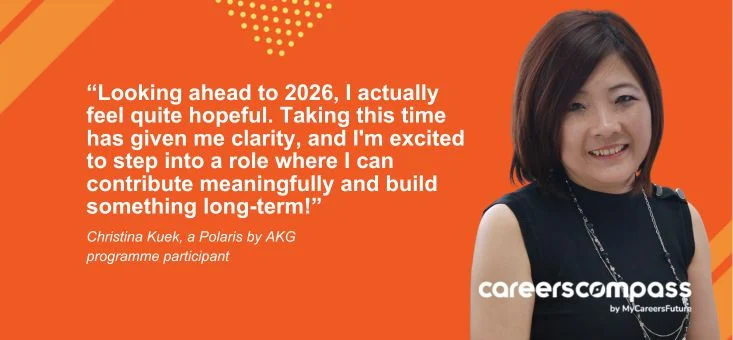
“Looking ahead to 2026, I actually feel quite hopeful. Taking this time has given me clarity, and I’m excited to step into a role where I can contribute meaningfully and build something long-term. I feel ready, and that feels good!”