


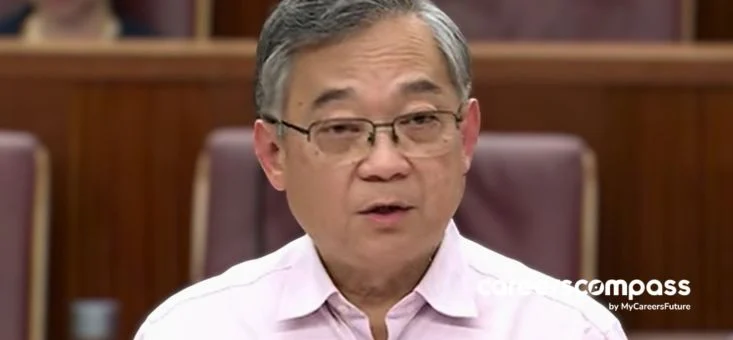
During this year’s Committee of Supply (COS) debate, Deputy Prime Minister and Minister for Trade & Industry (MTI) Gan Kim Yong shared the Singapore government’s gameplan for securing our next phase of growth and good jobs, and the support available to employers.
He opened by announcing that Singapore’s economy grew by 5%, performing better than expected despite the challenging global environment, but cautioned that Singapore must remain “clear-eyed”. He explained that the “rules that allowed Singapore to prosper for decades have fundamentally changed”.
DPM Gan cited the conflicts in the Middle East, as well as tariff disputes and trade wars that exemplify the unpredictable and uncertain global trading environment that we must now navigate.
Hire smarter, faster! Use MyCareersFuture’s innovative tools to find the right fit in record time.
In addition, with artificial intelligence (AI), automation, and our aging population, macro structural forces are also reshaping industries, businesses and jobs.
Here’s a quick round-up of what was brought up in Parliament that is aimed at helping employers in this environment.
Singapore’s “Business Refresh Package” for SMEs

Senior Minister of State (SMS) Low Yen Ling for Trade and Industry revealed that the government has tailored a “Business Refresh Package” that comprises a suite of enhancements to existing schemes. They aim to enable, equip, and empower small and medium-sized enterprises (SMEs) at every step of their journey to stay resilient, grow, and thrive by:
- Enhancing their productivity and cost efficiency
- Growing their revenue by helping them capture fresh opportunities at home and abroad
- Fostering a pro-enterprise and trusted business environment.
Here are more details on the package offered.
Streamlining processes for government grants
SMS Low announced that the government will streamline grant processes to make it easier for our businesses to access the full suite of available measures.
She announced a new grant called Enterprise Singapore (EnterpriseSG)’s three flagship grants.
It will be launched in the second half of 2026.
The new EDGE grant will support up to $100,000 per year for eligible activities. Businesses that require more support for customised projects can continue to apply to EnterpriseSG.
For enterprises with warehousing operations
They can tap on schemes such as the Enterprise Development Grant (EDG) for funds, and advisory support from industry partners such as Republic Polytechnic’s Centre of Innovation for Supply Chain Management (COI-SCM).
Extension of the Enterprise Financing Scheme (EFS)-Green scheme
In 2024, the Singapore government extended the Enterprise Financing Scheme (EFS)-Green for two years and expanded the scope to cover companies adopting green solutions, in addition to green technology developers.
SMS Low shared that EFS-Green will be extended for another five years, facilitating continued access to financing for companies seeking to build green capabilities and capturing new opportunities in the green economy.
In addition, to help companies manage rising energy costs and reduce their environmental footprint, the Energy Efficiency Grant (EEG) will be extended for one year. This will provide continued support for investments in energy-efficient equipment.
Financing for SMEs to be enhanced
Launched in 2019, the Enterprise Financing Scheme (EFS) has supported thousands of SMEs in securing financing for a wide range of business activities.
SMS Low revealed it will be enhanced for SMEs in two ways:
To allow borrowers greater flexibility in structuring loan facilities, the facility-level sub-caps of $20 million and $30 million per borrower group for the EFS-Trade Loan and EFS-Fixed Assets Loan respectively will be removed, while retaining the overall cap of $50 million.
This means that enterprises can obtain loan facilities that best meet their needs, whether it is fulfilling orders, executing projects, or undertaking capital investments.
Secondly, the scope of the EFS-Mergers and Acquisitions (M&A) will be permanently expanded, to support companies in securing financing for both domestic and overseas acquisitions.
Help for SMEs to go global
To help SMEs embark on internationalisation, SMS Low shared:
- There will be an increase in support levels for grant schemes that help businesses venture abroad, from 50% to 70% for SMEs, and 30% to 50% for non-SMEs.
This includes schemes like the Market Readiness Assistance (MRA) grant, the Business Adaptation Grant, and the Global Innovation Alliance (GIA).
- There will also be enhancements for the MRA grant. During MTI’s COS debate in 2025, the $100,000 grant cap was extended to 31 March 2026.

In 2026, in addition to extending the $100,000 grant cap, the new markets criteria will be removed, and there will be an extension of grant support to all local businesses, including both SMEs and non-SMEs.
This will not only support businesses in accessing new markets, but also enable them to deepen their presence in existing markets.
- The Double Tax Deduction for Internationalisation (DTDi) scheme will be enhanced, to help companies seize overseas opportunities with greater speed and certainty.
The expenditure cap for automatic DTDi-qualifying activities will be increased from $150,000 to $400,000, and make existing qualifying activities eligible for automatic deductions.
- The GIA will have a refreshed strategy which supports startups’ market expansion across two tracks, “Launch” and “Grow”.
Startups that are new to the market will be supported through the “Launch” programmes focused on market insights, shorter market sprints, and early customer and partner discovery.
Want to stay in the know? Receive hiring tips directly in your mailbox by signing up for our e-newsletters today.
Startups and SMEs requiring more tailored support can tap on “Grow” pathways to access specialised partnerships to support expansion, deeper market penetration, and accelerate technology maturation.
Help for heartland enterprises
To encourage the rejuvenation of heartland shops, the Enhanced Visual Merchandising Programme and the Heartland Enterprise Placemaking Grant (HEPG) will be increased from 50% to 70%.
Targeted support for tech startups

Minister of State for Trade and Industry Alvin Tan stated that Singapore’s startup ecosystem has evolved significantly over three decades.
Venture capital (VC) funding to startups more than quadrupled in the past decade, from US$1 billion in 2014 to US$4.8 billion in 2024.
To continue this momentum, he revealed the government will set aside $1 billion to expand the Startup SG Equity (SSGE) scheme, to continue investing in early-stage startups, as well as expand into growth-stage deep tech startups.
In 2022, the Singapore government set up the $1.5 billion Anchor Fund to attract and anchor listings of high-growth companies, including promising startups.
The bulk of the fund has supported companies in their journey towards public listing in Singapore.
MOS (Alvin) Tan shared the second $1.5 billion trache for the Fund will now be launched.
Support for specific industries
Semiconductors
Minister-in-charge of Energy and Science & Technology in the Ministry of Trade and Industry Dr Tan See Leng announced that the government will invest $800 million to establish the RIE Flagship in Semiconductors, focusing on high-impact technology areas such as Advanced Packaging and Advanced Photonics, which boost chip performance while cutting power use.
“The flagship will translate research into products and encourage more advanced R&D and manufacturing activities, creating good jobs in Singapore”, he shared.
Sharpen your hiring strategy. Get top candidates on MyCareersFuture.
In addition, continuing last year’s announcement by DPM Gan in NSTIC (R&D Fab), a semiconductor R&D fabrication facility, Minister Tan announced that there will also be an additional investment of $60 million in NSTIC (Power Electronics) to strengthen Singapore’s competitiveness in next-generation power electronics.
Such technology will aid the potential development of smaller, more efficient power systems, with use cases including extending driving ranges of electric vehicles.
Biomedical
In 2024, two R&D translational platforms – namely Nucleic Acid Therapeutics Initiative (or NATi) and MedTech Catapult were announced. They have since attracted global partners, uplifting local enterprises, and training talents to anchor high-value R&D activities and jobs in Singapore. There will be plans to further scale up these platforms.
Private Sector R&D
Through our Research and Innovation Scheme for Companies, or RIS(C), Singapore has attracted substantive private research and innovation investments, building capabilities and creating high-value jobs for locals.
Minister Tan shared that in the past five years, companies have committed more than $14 billion to research and innovation investments here, and created more than 12,000 jobs in research, development, and innovation roles – with locals filling more than 70% of these positions.
Building on this, he announced that there will be a further investment of more than $3 billion in RIS(C) in RIE2030.
New spaces for business synergies and growth
As mentioned in Prime Minister Lawrence Wong’s Budget speech, a new AI park called “Kampong AI” will be built. Minister of State for Trade and Industry Gan Siow Huang elaborated that the park is expected to be fully operational in 2028.
Startups will be able to house their researchers and developers here, leveraging on events, speakers and demos happening at the same place.
It will consist of two adjacent 7-storey developments: one block with 14,500sqm of business park units and event spaces, accommodating around 70 companies, while the other block houses 200 residential units.
In addition, JTC is launching an extension and refresh of LaunchPad @ One-North, turning it into Asia’s flagship startup destination.
The venue is currently Singapore’s main node for startups, and a major knowledge and innovation district, housing leading firms such as Grab, Razer, Sea, and research institutions such as Agency for Science, Technology and Research (A*STAR), National University of Singapore (NUS), National University Hospital (NUH), and Singapore Science Park.
This extension follows engagements with the startup ecosystem, including venture capital funds and accelerators. The refresh will essentially boost the vibrant environment for startups to work, live, and play.
MOS Gan also announced that JTC is master-planning an exciting new Woodlands Gateway district around the upcoming RTS Link station, which will be a northern gateway to the Johor-Singapore Special Economic Zone (JS-SEZ).
This mixed-use district, spanning up to 35 hectares — the size of about 50 football fields — will include a transport hub connected to the RTS Link and Woodlands North MRT stations. The first phase is expected to complete around 2030.
It will offer commercial and lifestyle amenities for commuters, residents, and people working in the Woodlands North area, and provide flexible industrial spaces. Given its proximity to the RTS Link, Woodlands Gateway will also cater to firms siting manufacturing in Johor with regional HQ functions here.
(Main Image: MDDI YouTube)
Follow us on LinkedIn for more expert career guidance and industry insights: Workforce Singapore on LinkedIn
Stay updated with the latest trends, job market shifts and career health advice from WSG.