


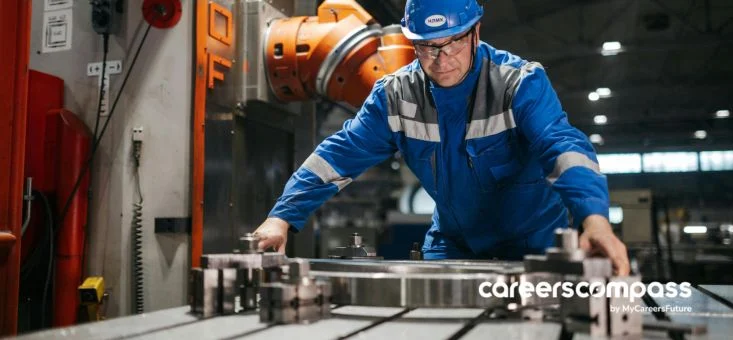
If you’re not already in the industry, you may wonder what exactly is the role of a manufacturing production technician. Simply put, before a product goes out to the public, a manufacturing production technician ensures these items are working in the way they are intended. The role requires a lot of collaborative work with other teams in the organisation, particularly the quality assurance team.
Here are some of the day-to-day responsibilities of the role:
- Checks that products are produced according to specifications
- Tests if equipment and devices are functioning well
- Troubleshoot faulty equipment promptly
- Keeps track and calibrates production equipment for productivity
- Works with engineers in developing and testing new products
- Manages the inventory of materials
- Ensures adherence to standard protocols
- Provides other technicians with process or product training
- Records data related to equipment used for operations
- Ensures environment, health and safety compliance matters are met
Career path of a manufacturing production technician
Here’s a quick overview.
Junior level (1-3 years of experience)
- Production technician
- Operations technician
- Manufacturing technician
- Shift technician
Mid-Level (4-8 years of experience)
- Production supervisor
- Senior/ technician, maintenance
- Production planning technical specialist
- Senior operations technician
Senior Level (8 years of experience or more)
- Senior production technician
- Senior chemical technician
Job hunt smarter, not harder. Find fresh listings every day on MyCareersFuture.
Technical skills required
Equipment maintenance
One of the responsibilities of the role is to ensure proper maintenance procedure is done on the relevant equipment. You will need to perform routine maintenance checks on various machinery when needed.
Knowledge of safety protocols
Conducting environmental safety inspections is one of the main tasks so to do this well, you need to be well-versed with environmental regulations, as well as health and safety standards.
Skills in Computer-Automated Technologies (CAT)
Modern manufacturing processes today are dominated by automated equipment. The ability to work with complex computers, including perform repair work when needed, is an advantage.
STEM skills
As companies often have manufacturing systems that rely heavily on automated programmes, having skills in Science, Technology, Engineering and Mathematics (STEM) will be beneficial to the role.
Soft skills required
Critical thinking skills
As you will need to evaluate and analyse information, possessing critical thinking skills will help you look beyond the obvious and use your reasoning ability make informed decisions.
Active listening skills
This skill is helpful in gleaning information by asking appropriate questions to clarify technical details. Having the ability to listen actively can help you focus on verbal and non-verbal cues on the production floor.
Communication skills
Being able to communicate effectively contributes to the team’s result delivery and improves team dynamics.
High aptitude for technology
Having an interest and aptitude for technology and staying up to date is helpful. Some useful software includes Microsoft Dynamics AX 2012 Lean Manufacturing, Hubstaff and Oracle Netsuite.
Opportunities for Continuous Education
To become a manufacturing production technician, you should have at least a NITEC or diploma in any field. But the learning doesn’t stop. There are many opportunities to upskill and develop your career. Here are some certification courses to consider.
Six Sigma
Taking Six Sigma certification courses for the manufacturing sector can help save time and resources, improve productivity and enhance customer satisfaction. Institutions such as the National University of Singapore and Singapore Management University have intensive lean courses for every Six Sigma level (White Belt, Yellow Belt, Green Belt, and Black Belt), while online platforms like Udemy and FutureLean also offer workshops on this methodology.
Specialist diploma in Smart Facilities Management
As automation of facilities becomes more common across industries, this certification is useful in familiarizing how systems and processes of smart facilities can complement their duties.
Specialist diploma in Workplace Safety and Health
One of the main tasks of a manufacturing production technician is conducting safety inspections, so having such a certification can equip you with updated information on legal compliance issues, as well as the knowledge to efficiently identify, assess and address workplace hazards.
This article is contributed by Jobstreet by Seek.