

Prime Minister (PM) and Minister for Finance Lawrence Wong framed his Budget Statement in February around the changes both the workforce and employers would need to make to “succeed in this new reality”.
Various tax incentives, training programmes, and coordinated national missions became focal points in Parliament during the Committee of Supply (COS) debates that followed. Several Members of Parliament (MPs) called for new industrial policies and structured support to help Singapore workers navigate AI-driven job transformations.
Need talent? Post jobs to 500,000+ locals now. Find your next hire on MyCareersFuture today.
AI Literacy: Empowering employers’ AI transformation
Deputy Prime Minister and Minister for Trade and Industry Gan Kim Yong said during the COS debates in Parliament the government’s goal is to empower Singapore companies to:
- Harness AI end-to-end
- Redesign business processes
- Embed AI into core operations
- Develop proprietary applications
- Transform workflows
- Upgrade jobs and skills
To advance these objectives, a “Champions of AI” programme will be launched later in 2026.
He announced that the programme targets a select group of Singapore-based companies with the ambition and commitment to make AI a core driver of productivity, innovation and growth.
“We will partner these companies to transform their businesses, by embedding AI across core operations, organisational processes, and workforce practices”, he said.
This includes leadership and workforce training, as well as support to develop and execute AI transformation projects with clear and measurable business impact.
These companies will also invest in retraining and upskilling their employees, enabling their workers to take on high-value AI-enabled job roles.
AI Missions — starting with advanced manufacturing, connectivity, finance and healthcare — will also be established, said DPM Gan. Around each Mission, full-stack ecosystems will be built, including datasets, computing resources, regulatory sandboxes, and solution providers. This will shorten the path from development to deployment, and from testing to scale for companies in these industries.
DPM Gan believes “these Missions will generate demand for new skills, creating clusters of expertise anchored in Singapore”.
All sectors of the workforce will have to pivot, as part of lifelong learning
What is clear is that the status quo for careers, whether you’re a fresh graduate, a mid-careerist or a senior worker, is changing, and fast.
According to reports in the Straits Times, NTUC deputy secretary-general Desmond Choo addressed young workers’ concerns on the decline of entry-level jobs, emphasising that in fact, it was time to act now to recreate the very notion of what entry-level jobs are, and to “turn this disruption into an opportunity”.
For mid-careerists, MP Wan Rizal, who is director for stakeholder management at NTUC’s Employment and Employability Institute, empathised with mid-career workers who are facing a difficult balancing act.
These workers juggle reskilling and upskilling in the midst of redesigned jobs, while managing caregiving and financial commitments.
This is why it’s important for such training initiatives to clearly outline the career opportunities that will follow.

MP Poh Li San summed up the mood of the times saying: “We no longer can count on our initial degrees bearing us through our careers without supplements.”
“Continuous education is a way of life, no matter our professions.”
Jonathan Y. H. Sim, a lecturer at the NUS Learning & Development Academy and Fellow at the NUS Teaching Academy, believes the rapid growth in AI capabilities means everyone will need to grasp the risk and opportunities that are coming.
“Two or three years ago, many of us used to say that large parts of knowledge work were relatively safe because AI couldn’t reliably problem-solve and didn’t have evaluative judgement — it couldn’t tell whether a piece of work was good or bad.”
We are now starting to see early signs of AI systems that can do some of these things, at least in narrow contexts, he believes.
Even when the output is imperfect today, the emergence of this capability is a signal that they will only get better here on now.
That’s why AI adoption is so urgent. For employers, it affects competitiveness, productivity, and risk management: the organisations that learn to adopt AI safely and effectively will gain a significant strategic advantage over their competitors, while those that wait may find themselves scrambling.
For employees, it changes the nature of work and the skills that remain valuable, especially in white-collar professions. “The moment we’re in is analogous the period pre-COVID: the early signals are present, but many people still assume nothing will happen until it suddenly does”, Jonathan said.
SMEs will have to step up their game
Much will also depend on how companies, particularly small and medium enterprises (SMEs) adapt to this new normal, both in terms of job redesign, as well as reskilling and upskilling their workers.
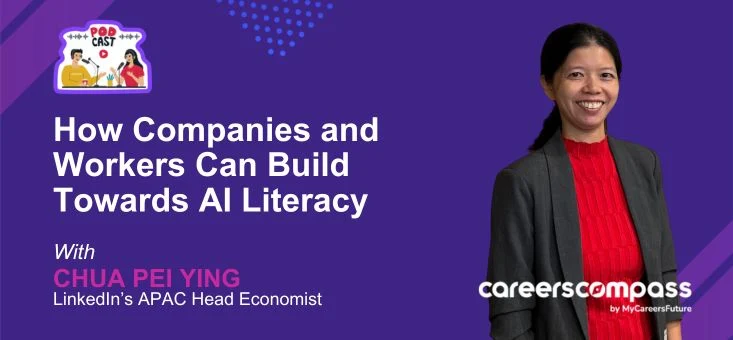
According to LinkedIn’s APAC Head Economist Chua Pei Ying, the level of AI literacy penetration in SMEs is four to five times lower than in large MNCs!
“If not addressed, this gap will widen the divide between the companies who can harness it and those who can’t.”
“But AI also offers an opportunity — to help SMEs level up as technology lowers traditional barriers to entry.”
“In this regard, I think that Budget 2026’s offering of the Productivity Solutions Grant to give additional support to SMEs for AI adoption is a step in the right direction,” she added.
For eligible local SMEs, the PSG typically co-funds up to 50% of qualifying costs, with support of up to S$30,000, across a mix of industry-focused tools and general business software.
At the 2026 COS Debate, the Ministry of Education (MOE) also announced that there will be a new SME AI Skills Launchpad. This is developed with industry partners to support SMEs in elevating AI awareness and facilitating the adoption of AI solutions and training.
SkillsFuture Queen Bees and Skills Development Partners (SDPs) will support SMEs through AI-related masterclasses and advisory support, and they will also have access to a comprehensive AI resource page on the SkillsFuture for Business Portal, as well as curated AI skills and courses on the TalentTrack+ platform.
These initiatives will be progressively rolled out from March 2026.
Shifting mindsets: From AI anxiety to AI literacy
Jonathan believes that Singaporeans need to move away from fearing job loss to truly begin adopting AI and its full potential.
For employers trying to guide their workers towards reskilling and upskilling towards AI, he said: “In my own teaching experience, people adopt new tools more deeply when we can arouse a sense of curiosity and excitement.
“If we want widespread experimentation, we have to help people get excited and enjoy using these tools, not just out of anxiety!”
He believes that anxiety-driven adoption only breeds resentment, adding: “Personally, I’ve also found that one of AI’s most surprising values is reflective: it can be a tool that helps people think more clearly, learn faster, and even become more human and humane – and that is if we approach it intentionally.
Make better hires, faster. Join thousands of employers on MyCareersFuture today!
“That framing of AI as a catalyst for growth and development, may be more effective in encouraging people than abstract language about strategy alone.”
But don’t worry — we are not called to all be AI engineers, but rather, to become AI literate, according to LinkedIn’s APAC Head Economist Pei Ying Chua.
To help workers assess their AI readiness level and training needs, SkillsFuture Singapore (SSG), in partnership with the Singapore Institute of Technology (SIT), will develop a self-diagnostic AI readiness tool, which individuals can access via the MySkillsFuture (MySF) portal.
Through this tool, users will be able to gauge their AI readiness level based on various worker archetypes and receive course recommendations appropriate for their readiness level.
As part of SSG’s enhancements to the MySF portal, the curation and signposting of SSG-supported AI-related courses will be improved, with courses tagged by archetype to help workers identify relevant courses.?
The self-diagnostic tool, together with the enhanced MySF portal, will be rolled out by 2Q 2026, according to the Ministry of Education at the 2026 COS debate.
The road ahead on integrating AI into work
The short term
For employers and workers trying to figure out what to do next, Jonathan shared that the biggest feedback he receives is that GenAI, in its current form, still cannot be used reliably to automate many non-coding tasks end-to-end.
It often makes mistakes, misses context, or produces work that looks plausible but isn’t quite right.
But what it does – with immediate impact – is change how we work, he believes.
The medium term
We should expect reliability to improve vastly. We’re already seeing early signs of systems with more genuine problem-solving behaviour, tools that can figure out subtasks, learn workflows, and operate more independently.
If the economics become favourable, through better pricing, accessibility, integration improves, knowledge work will be heavily reshaped.
Jonathan believes the work most at risk in this phase is fundamentally:
- Information-passing (summarising, translating, rewriting, conveying), and/or
- Pattern matching (classifying, diagnosing routine cases, triaging, spotting common anomalies).
“Even in medicine, for example, many of my medical colleagues acknowledge that a significant portion of general practice involves pattern recognition – matching symptom clusters to likely causes”, he said.
That’s exactly the kind of task AI tends to excel in over time, Jonathan said.

Meanwhile, work that holds up better tends to be work with low recurrence, high novelty, or high contextual complexity, because AI is trained on historical data.
If the task is genuinely new, ambiguous, or dependent on local context and judgement, then we cannot rely on historical data to guide the AI’s decisions. Human input still remains essential.
The long term
Fewer industries will “vanish” for good than what people typically assume. Instead, many industries and roles will be forced to reinvent themselves.
And there’s one more possibility people underestimate, Jonathan said.
“I believe there will be a niche – and in some domains, a premium – for 100% human work, similar to counter-movements we’ve seen, in recent revivals of film photography, vintage fashion, or vinyl records.”
As AI content becomes abundant, human craft and the human touch will become more meaningful and valuable in certain contexts, not less, he concluded.
We speak more with Pei Ying for further insights on why AI is such a big focus in Budget and COS 2026- check out our podcast on what these implications mean for local employers and jobseekers!
Key highlights to listen to
(1:19) How SME’s are really doing in integrating AI
(4:48) Do you need to hire workers who are plug-and-play for AI?
(6:36) How will AI affect your business and career industry?
Follow us on LinkedIn for more expert career guidance and industry insights: Workforce Singapore on LinkedIn
Stay updated with the latest trends, job market shifts and career health advice from WSG.