


Your questions about job hugging answered
-
What does job hugging mean?
-
What is the difference between job hugging and quiet quitting?
-
What is causing job hugging in Singapore?
The past few years have been marked by many career trends. First the “Great Resignation” in the post-Covid era, to “Quiet Quitting” and “Quiet Cracking”.
It’s becoming evident that larger macro-economic factors have shaped these trends, as employee and worker sentiment and psychology get influenced by these broader trends.
We’re now on the cusp of another, with the latest being called “job hugging”, or less original-sounding, “The Great Stay.”
What “job hugging” is and why it is trending
Essentially, it’s when employees and workers start clinging to their current jobs, even if they’re unhappy in these roles. Such behaviour is simply because the uncertainty of the economy, news of layoffs, or just sheer inertia for change.
This phrase describes employees that still attend their job each day, yet only put in the bare minimum effort to complete their tasks.
Job hugging versus quiet quitting
Job hugging is different from quiet quitting. Job hugging is about clinging to your current position even when unhappy, driven by reluctance to leave, while quiet quitting is about staying in your role but disengaging—showing up each day whilst putting in minimal effort.
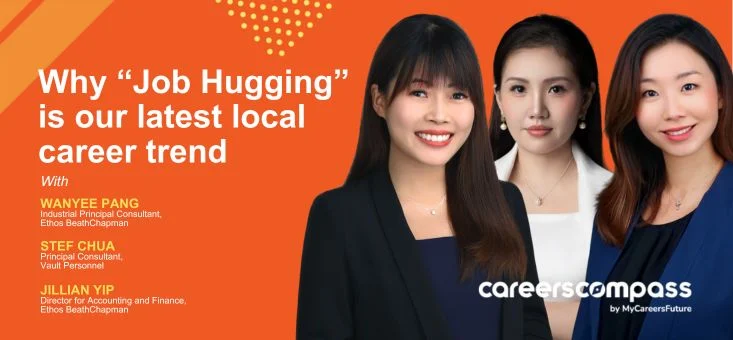
This isn’t just happening overseas — according to Vault Personnel’s principal consultant Stef Chua , and Ethos BeathChapman’s Wanyee Pang and Jillian Yip. Wanyee is an industrial principal consultant, while Jillan holds the title of director for accounting and finance.
Root causes of job hugging in Singapore
The trio agree that the job hugging mentality has hit Singapore shores too, with detrimental effects for employees and workers for both small-to-medium enterprises (SMEs) and multi-national corporation (MNC), as their employers.
Job hugging in Singapore is largely driven by economic uncertainty and a heightened fear of job loss. With global economic headwinds, rising costs of living, and periodic waves of retrenchments across various sectors, many workers feel compelled to hold onto their current positions—even when dissatisfied—rather than risk unemployment.
The financial pressures of managing mortgages, supporting families, and maintaining Singapore’s high standard of living make the prospect of losing steady income particularly daunting.
This fear is further amplified by concerns about age discrimination and market competitiveness. Older workers, in particular, worry that leaving their current roles might make it difficult to secure comparable positions, especially in industries undergoing rapid transformation.
The perception that job opportunities are scarce—coupled with stories of prolonged job searches and competitive hiring processes—reinforces the instinct to “hug” existing jobs tightly. In this climate, staying put feels safer than venturing into an uncertain job market, even when career growth has stalled.
The experts share more with us below.
Are SME employers seeing reduced staff turnover due to workers’ job security fears?”
Stef: Across certain industries, yes —F&B, Retail and Hospitality. Hiring processes are prolonged from multiple interview rounds to ensure a good cultural fit. The rigorous vetting reflects employers’ cautiousness due to evolving nature of job roles, especially with the rise of AI.
There has been news on layoffs since the start of the year. Millennial workers seem less likely to move during this period while Gen Z workers are likely to leave the company if the job isn’t meaningful or culture mismatch.
The former likely chooses to stay put over marginal pay increases and hence will think twice before making a move. For Gen Z workers, most of them are still staying together with their parents — that lightens their personal responsibilities altogether.
SME employers are also speeding up on retention strategies with job redesigning and performance framework in hope of better retention.
To me, this trend is likely to be due to the relatively bleak general economic outlook as a result of new tariffs, and conflicts/wars in the world. Employers are more cautious when it comes to hiring, particularly mid to senior level.
In Singapore context, the high labour cost, high salary expectation and wage benchmarking across market are likely what is causing SME employers to be more conservative in their hiring. More background checks and talent assessments are deployed to suss out new hires as accurately as possible, and make sure they’re a good fit culturally.
SME employers these days are more inclined to invest in technology or AI, as compared to years ago for productivity and efficiency purposes.
Certain functional roles are also outsourced simply for the purpose of compliance without fearing lapses of work due to attrition.
Are these trends also showing for the MNC job market?
Wanyee: Yes definitely. Over the past few years, uncertainty in the market has made employees far more cautious about changing jobs.
Many fear the “last-in, first-out” risk if downsizing occurs. For those with families or significant financial commitments, stability tends to outweigh the desire for change. We’re also seeing flexibility play a key role in retention.
Employees who already enjoy hybrid or flexible work arrangements are less inclined to take the risk of moving, especially when it’s unclear if a new employer can offer the same balance. Increasingly, these non-monetary factors have become just as important as pay or title.
Broader market sentiment also plays an important part in decision making. Employees often hear stories from peers or former colleagues who have made job moves only to face challenges such as cultural misalignment, instability, or unfulfilled promises.
These shared experiences reinforce the perception that it might be wiser to “stay put” rather than “rock the boat,” particularly when the external environment feels unpredictable.
Where rapid career moves were once common, today’s workers are taking a more measured and pragmatic approach. They’re prioritising security, balance, and predictability over speed of career progression.
Read Also: Mid-Career Switchers: Plan Ahead for Your Career by Understanding What the Hiring Market Needs
Pros and Cons for Workers who plan to or are already “job hugging”?
Jillian: Employees who choose to “wait it out” in their current firm may stand to gain, especially if they are staying for the right reasons and in a supportive environment.
For instance, they may have recently transitioned into a new role that adds value to their portfolio, or taken on additional responsibilities that they might not have received as new joiners elsewhere.
In today’s volatile market, it is common to experience uncertainty in one’s role, particularly when witnessing events such as cost-cutting, restructuring, or the relocation of roles to lower-cost countries. In my view, this serves as a kind of “test” of how employees respond in a VUCA environment — one that is Volatile, Uncertain, Complex, and Ambiguous.
Do they leave at the first sign of instability, or do they stay to ride the wave, and possibly be rewarded when the tides turn, such as through new internal opportunities or promotions when times are better?
On the flip side, “job hugging” can be counterproductive when employees choose to stay in their current role for one sole reason — comfort and stability, even at the risk of stagnation.
While familiarity can provide a sense of security, staying too long in a role without growth opportunities may lead to a myopic world view, skill atrophy, or even reduced candidate marketability over time.
In such cases, the comfort zone becomes a barrier rather than a safety net. Employees may find themselves missing out on new challenges, exposure, or experiences that could otherwise stretch their capabilities and accelerate their career trajectory, if they had taken that leap of faith.
Are there any age, industry or occupational demographics that would be more likely to “job hug”?
Stef: As they are at a stage where they have commitments, health concerns or doing family planning, Gen X and Millennials tends to job hug. Moving to a new role could mean less flexibility, 100% onsite, adjusting to new scope and environment. As the years passes, it’s normal for one to be less resilient to changes.
They tend to prioritise job stability and work-life balance, as compared to pre-covid.
Women tend to job hug in a flexible environment where they could manage both work and family commitments, more so during the earlier year of caregiving.
If this becomes a prevalent career strategy, what advice would you give Singapore workers to do it effectively, without hurting their long-term prospects?
Jillian: My advice would be to have clarity on your mid- to long-term career aspirations. If staying in your current role does not hinder your overall career trajectory or the direction you aim to move toward, then there is no harm in staying. This is especially if it offers you growth in other forms, such as broader exposure, deeper expertise, or leadership opportunities.
However, if the role no longer aligns with your future goals or leaves little room for development, it may be worth reevaluating your options. Staying should be a conscious choice, not a convenient one.
It is also important to remember that staying in a role does not automatically guarantee job security.
Remaining in the same position at the expense of learning and growth can be risky, especially if the motivation is purely to seek job stability. In reality, especially in this current market, no role is ever entirely “safe.”
I have seen many long-serving employees still affected by restructuring or cost-cutting measures, despite their good performance and long tenure.
At the end of the day, it is not about how long you stay, but how much you grow while you stay. “Job hugging” itself is not necessarily negative, and staying in a role for stability or comfort can be entirely valid.
The difference lies in how you make use of your time. If you continue to learn, take on new challenges, and expand your skill sets, staying becomes a form of career building.
If growth and learning have plateaued, then staying risks stagnation.
After all, when it comes to your career, are you staying just to avoid the unknown, even when the risks within your role may be just as significant as those outside it? Learn why Job Hugging is the new trend now in Singapore.
Follow us on LinkedIn for more expert career guidance and industry insights: Workforce Singapore on LinkedIn
Stay updated with the latest trends, job market shifts and career health advice from WSG.