



Your questions about skills-first workforce answered
- What does a skills-first approach mean for salary negotiations?
- How can employers better utilise their workforce through skills-first practices?
- How can career guidance improve job prospects?
The SkillsFuture movement’s 10th Anniversary Jobs-Skills Insights (JSI) report was jointly launched by SkillsFuture Singapore (SSG) and Workforce Singapore (WSG), in partnership with the Institute for Adult Learning (IAL) and Burning Glass Institute (BGI).
It spotlights the latest jobs-skills trends as Singapore aims to build a skills-first workforce. What the report found was that job roles in Singapore are experiencing varying degrees of shifts in skill requirements, alongside workplace transformation and emerging trends such as digitalisation and sustainability.
In addition, more than half of the workforce are involved in workplace transformations that require increasingly complex skills.
As Singapore President Tharman Shanmugaratnam reminded in the foreword about the challenges facing our country, individuals, employers, unions and society as a whole have to respond to the changing nature of work.
He added: “Yet both the challenges and opportunities have only become larger.”
“Advances in artificial intelligence, robotics and other technologies will reshape many more jobs across the workforce than it would have been thought just a decade ago.”
“The green transition will also make some jobs redundant while creating many new openings, locally and abroad, but at the same time, our workforce itself is getting older.”
What is a skills-first approach in salary negotiations
A skills-first approach transforms salary negotiations by shifting focus from job titles and years of experience to the actual value and capabilities brought to the role. Instead of negotiating based on previous salary or tenure, professionals can leverage their specific skill set and demonstrated competencies to justify compensation expectations.
This approach allows individuals to highlight transferable skills from different industries or roles that directly contribute to the position’s requirements. For example, when moving from marketing to product management, one can emphasise skills like data analysis, customer research, and project coordination that are valuable across both functions.
Professionals can also negotiate for skill development opportunities, training budgets, or certifications as part of their compensation package, viewing these as investments in long-term earning potential rather than just immediate monetary benefits.
Working hand in hand in transition to a skills-first workforce
Businesses play a vital role in the transition to a skills-first workforce.
To fully harness the potential of our dynamic economy, employers must adopt skills-first practices. It is crucial for them to make skills a priority in multiple areas such as job design, hiring decisions, learning and skills development, talent development and internal mobility, and performance management and reward frameworks.
For employees, proactive career planning, targeted training and informed career development decisions can help enhance their career health. This helps ensure both immediate employability and long-term career resilience.
Both employers and employees can tap the full potential of business and workforce transformation by adopting the following practices:
- Designing jobs that better utilise skills across the workforce
- Hiring based on skills and competencies required for the job, which can be validated not just through formal qualifications and credentials
- Developing skills that are aligned to current and future business needs.
- Rewarding contributions from skills
As it stands, the report found that employers are actively redesigning job roles to align with evolving business and workforce needs. At the same time, companies are also implementing job redesign and reskilling programmes to support this transformation.
Notably, one-third of employers expressed strong interest in enhancing their data analytics capabilities to strengthen business decision-making processes.
The effectiveness of such job redesign and reskilling programmes is demonstrated by the high talent retention rate of WSG’s Job Redesign and Reskilling Career Conversion Programme (CCP), with more than 80% of participants remaining in the same firm one year after the programme!
As such, Singapore needs to double down on its efforts to move towards a skills-first approach if it is to thrive amid rapid change.
While qualifications remain relevant — because they signal the skills that an individual has — they cannot be the only deciding factor for employers, Education Minister Desmond Lee said to the Straits Times.
“If we rely on qualifications alone, we will miss out on the capabilities and experience that formal qualifications do not capture,” he said at the launch of the Centre for Skills-First Practices at the Lifelong Learning Institute in October 2025. “Individuals could also have picked up skills in the workplace, which may not be reflected in these qualifications.”.
“This does not mean that we have to choose only skills or qualifications. Rather, a skills-first approach means that we put the focus on skills in hiring, training and career progression.”
Make better hires, faster. Join thousands of employers on MyCareersFuture today!
To make a skills-first approach possible, Minister Lee believes three things need to happen:
- Businesses need to proactively identify and invest in the skills of their workers;
- Individuals need to be deliberate in their training and career choices; and
- Training providers need to accurately meet these skills needs with training.
Keen to learn more about the report? Here are five other key findings that you might find interesting.
1. Singaporeans need to look beyond academic qualifications
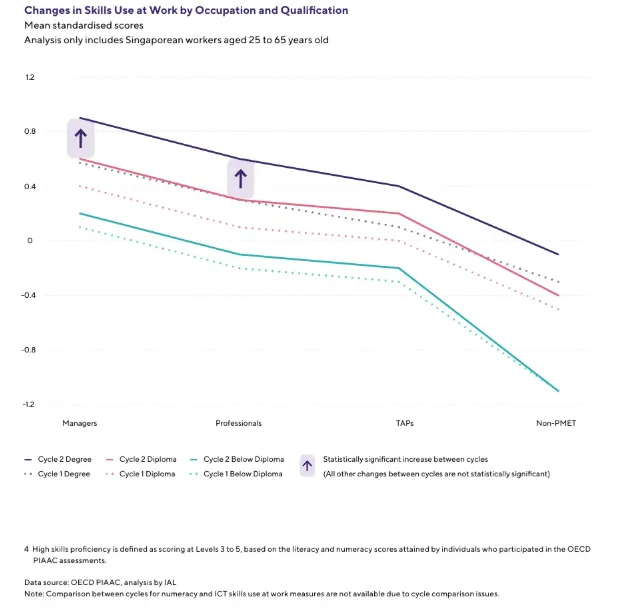
Between 2014/15 and 2022/23, the largest increase in skills demand is seen among degree-holding managers and professionals.
In contrast, for workers with diplomas and below, jobs remain simpler, with fewer growth opportunities and limited growth in skills demand. This is despite the fact that nearly 40% of them have high skills proficiencies.
This widening gap shows a talent pool that could be better utilised through improvements in job design. Without taking action, firms risk continuing to fall short in fully leveraging their workforce to achieve business objectives.
2. There is room for non-PMET roles to be transformed
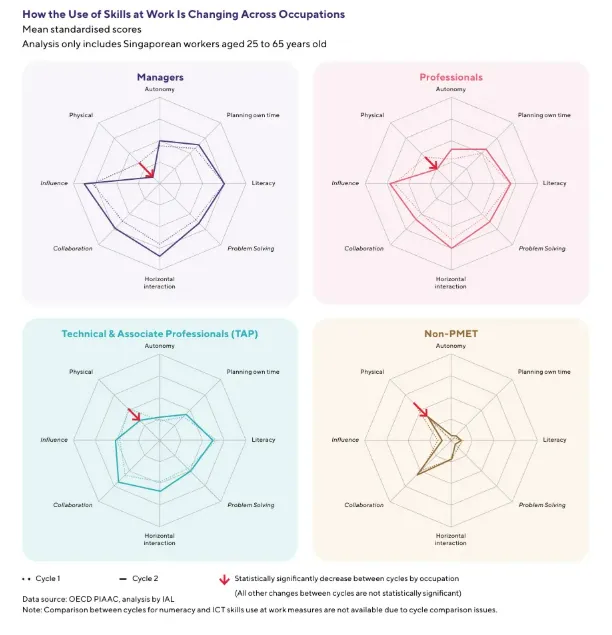
While physical tasks have declined across all job roles, many non-PMET jobs still demand low skills use and have not grown in complexity.
This suggests that there is potential to redesign these jobs to support transformation activities. If the gap is not addressed, Singapore risks developing a two-speed workforce, where some jobs advance while others remain stuck in under-stimulating work. As such, this may weaken business resilience and constrain growth.
Need talent? Post jobs to 500,000+ locals now. Find your next hire on MyCareersFuture today.
Employers can act by making job redesign a strategic business transformation lever. Non-PMET job roles can be enriched through increased autonomy, problem solving, and communication.
Together with targeted upskilling, reskilling and inclusive practices, this opens pathways for all workers to contribute meaningfully to business change, while ensuring that firms are equipped with adaptable talent for the future.
3. Salaries should start reflecting skills, not qualifications
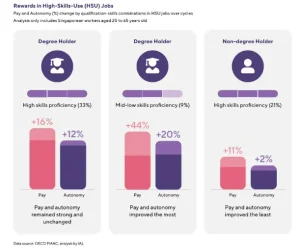
Degree holders with mid-low skills proficiency have seen the biggest gains in both pay and autonomy, matching those of high-skilled degree holders. However, high-skilled non-degree holders have seen minimal improvement, despite having a similar skills profile as their degree-holding counterparts.
As such, it is vital that employers close the value gap by rewarding contributions from workers’ skills. Recognising employees for their skills impact helps ensure they continue to build skills, sustain motivation and unlock the full value of their capabilities.
In addition, when employers hire based on skills instead of traditional academic qualifications, they get access to a wider talent pool.
4. Career guidance helps local workers improve prospects
The top three motivations for Singaporeans seeking personalised career guidance services were:
- Uncovering talents and skills gaps (72%)
- Exploring other roles (61%)
- Making informed career decisions (52%)
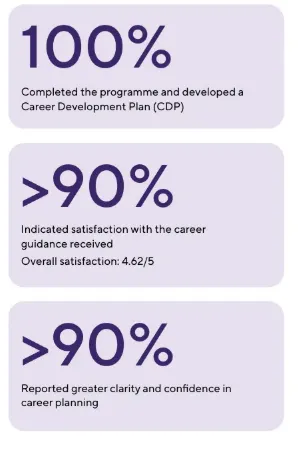
In fact, more than 90% of participants reported greater clarity and confidence in career planning after receiving structured and personalised career guidance.
WSG’s Polaris, helps individuals elevate their careers through structured and personalised career planning. Under this initiative, certified career coaches guide individuals to assess their values, interests, personality, and skills, and to develop a Career Development Plan, outlining clear goals and a roadmap.
5. Successful outcomes towards skills development ensue from career guidance
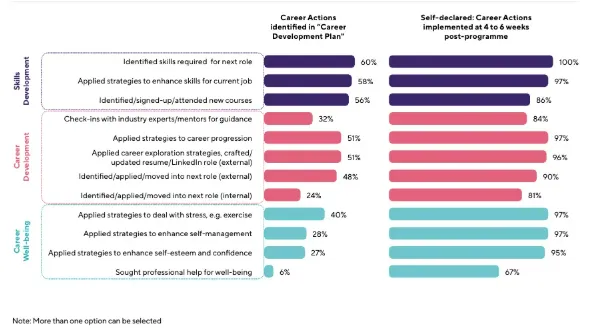
Moreover, the Career Development Plan identified specific career actions that were categorised into three key areas:
- Skills development
- Career development
- Career well-being
Skills development emerged as the predominant focus, with 60% of participants identifying the need to determine skills required for their next roles.
Within one month of programme completion, participants reported high career plan implementation rates. Other career actions, including skills enhancement, career progression, stress management, and self-management strategies, achieved 97% implementation rate.
Follow us on LinkedIn for more expert career guidance and industry insights: Workforce Singapore on LinkedIn
Stay updated with the latest trends, job market shifts and career health advice from WSG.